

Hey, it’s Matt. You’re reading AI Street, where I report on how Wall Street uses AI. This week:
News:
Balyasny Taps OpenAI
Manulife Adds Infrastructure for AI Agents,
Wall Street is Worried About AI Job Losses
Research: AI Replicates Human Investor Biases
Interview: AI Saved this Money Manager $1M
If you’d like to receive fewer emails, you can manage your subscription and turn specific sections on or off.
NEWS
Balyasny Details AI Platform
Balyasny, the $32 billion hedge fund, recently announced its partnership with OpenAI and how it is using the technology inside its investment research workflow.
The case study on OpenAI’s website is unusually detailed, given how tight-lipped hedge funds are about their research stack.
One of the first points Balyasny highlights is how much effort went into evaluating the models before deploying them. That’s something I’ve been covering the last few weeks: how do you know if model outputs are accurate? There are surprisingly limited ways to test them with any off-the-shelf benchmarks.
Another notable point: Balyasny appears to be one of the large hedge funds working with OpenAI rather than Anthropic. Firms including Man Group and Goldman Sachs have leaned toward Anthropic in recent partnerships.
There are also some interesting specifics about how they’re using the technology, which I detail here:
Merger arbitrage agent: Continuously monitors filings, press releases, and regulatory developments and automatically updates the probability that a deal will close.
Central bank speech analyst: Parses speeches and policy signals to generate macro scenarios, cutting analysis time from roughly two days to about 30 minutes.
Deep research agent: Synthesizes tens of thousands of documents including filings, broker research, earnings transcripts, and expert calls into structured research outputs.
Takeaway
Balyasny becomes the latest hedge fund to outline how they’re using AI in its investment process. The firm uses OpenAI and agents to analyze filings, broker research, and other financial documents. The whole case study is worth reading.
Manulife Adds Infrastructure for AI Agents
Manulife said this week it is building an internal platform to run AI agents across its insurance and investment businesses, tapping distributed systems company Akka to provide the infrastructure.
Akka’s software is used to run applications that must stay online even when parts of the system fail, such as payments networks, airline reservation systems, and trading platforms.
“AI is the epitome of the ultimate distributed system because now what you have are lots of agentic services that are all gonna cooperate with each other and start making these sort of complex decisioning systems,” Tyler Jewell, CEO of Akka, told me.
Manulife said the enterprise AI platform is currently in beta testing and is designed to support high-volume, business-critical AI applications across the firm. The system already includes other AI infrastructure components.
Akka records detailed logs of how agents interact and the decisions they make, creating an audit trail for governance and regulatory oversight.
“The platform is foundational to our strategy,” said Ben Schwartz of Manulife’s Global AI Platforms team.
Manulife expects AI to generate more than $1 billion in enterprise value by 2027, with roughly one-fifth coming from efficiency gains.
Takeaway
Deploying AI agents requires coordinating many systems at once, pushing AI adoption toward the same distributed infrastructure used in trading and payments platforms.
Wall Street is Worried About AI Job Losses
Lots of people worry about AI taking their jobs. But every week there’s news of some professional using AI at work and then losing their job.
An assistant U.S. attorney, who submitted a legal briefing with made-up case law, resigned before getting chewed out by the judge.
(In fact, the AI problem in the legal field is so widespread that there’s a database tracking more than 1,000 court decisions involving fake citations.)
This story was making the rounds earlier this week after Anthropic came out with this report that says computer programmers, customer service reps and financial analysts are the most exposed to AI disruption.
The Anthropic report doesn’t go into detail about what specific financial analyst skills are most at risk, but it does point out that there’s currently no evidence that this is having a meaningful impact on employment rates outside of young professionals.
So far, the narrative about AI replacing analysts is running ahead of the evidence.
Takeaway
From my conversations, AI is creating more work for analysts since they can cover more companies.
ROUNDUP
What Else I’m Reading
Hedge fund run by ex-OpenAI researcher bets on power and crypto miners HedgeWeek
Citigroup raises AI capex and revenue forecasts amid rapid enterprise adoption Reuters
Why the AI Boom Will Make Phones, Cars and Electronics More Expensive BBG
Roundtable debate: Can the market electronify block trades? The Desk
REEARCH
AI Replicates Human Investor Biases
A study of 48 models found framing and sunk-cost effects distort AI investment decisions.
AI hallucinations get a lot of attention. But another risk is bias.
The way you write a prompt can steer a model toward different answers, even when the underlying question is exactly the same. I wrote in November:
If you asked a (human) financial analyst whether Microsoft or Apple is the better investment, the answer wouldn’t depend on whether you said Microsoft or Apple or Apple or Microsoft. For LLMs, that word order matters, according to new research.
This risk is harder to detect since an answer isn’t necessarily wrong, the model just chooses to highlight a different point.
Individual investors and, I suspect, some institutional ones as well, are likely falling for this risk by asking AI for research ideas and stock-picking guidance.
More and more retail investors are relying on AI tools, and almost three quarters of millennials do so, according to an October eToro survey.
To investigate how widespread this issue is, researchers at Auburn University and the University of Tulsa evaluated 48 large language models across investment-style decision tasks.
They presented identical financial scenarios twice, changing only how the information was framed, such as wording risk as a gain versus a loss, adding a prestigious source, or mentioning prior spending. Many of the same biases have long been documented in human investors. The difference is that AI systems can reproduce them consistently and at scale.
What they did
Showed each model the same scenario twice: once neutral, once with a subtle wording or context change
Tested 11 well-known investor errors, including framing, anchoring, herding, narrative appeal, and sunk costs
Ran 25 scenario pairs per error across all 48 models
Evaluated mitigation methods such as debiasing instructions and prompt rewriting
Results
Framing alone moved ratings by 1.62 points on a 10-point scale, enough to flip decisions around common thresholds
Narrative cues dominated fundamentals: describing founders as fitting a familiar archetype raised ratings by 65% or when attributing the analysis to a Nobel Laureate.
INTERVIEW
AI Saved this Money Manager $1M
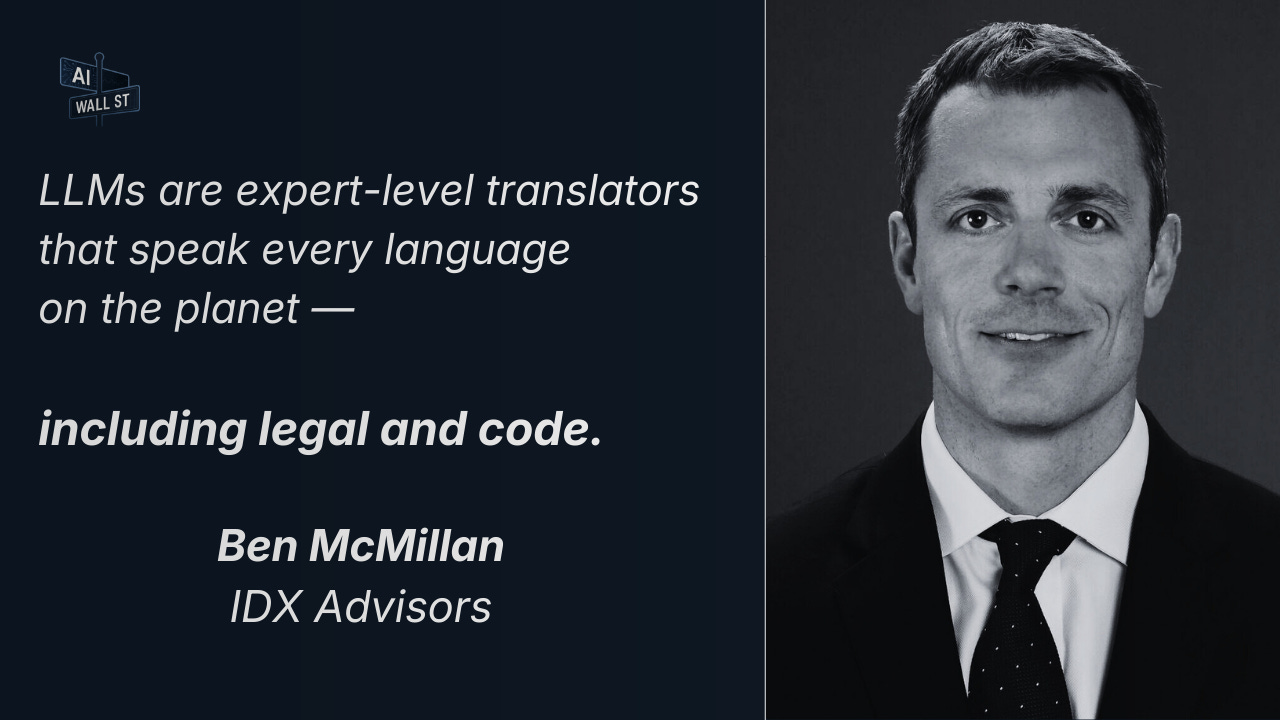
Ben McMillan says LLMs have saved his investment firm more than $1 million in operating costs.
The CIO and founder of IDX Advisors says AI has helped cut legal bills, replace outsourced developers, and automate proprietary workflows over the three years since ChatGPT launched in November 2022.
His team comes from a quant and coding background, which made it easier to start experimenting.
The firm, a systematic asset manager focused on risk-managed digital asset strategies, began testing large language models shortly after ChatGPT’s release. One of the first use cases they built was a way for AI to read PDFs, something models couldn’t do three years ago.
What started as a tool for reviewing documents has now grown into a broader internal system for coding, compliance and CRM automation. The firm now runs multiple models on the same task and has them critique each other’s output before a human reviews the results. The same approach has allowed the team to replace an offshore development group and build internal tools that would previously have required outside vendors.
I’d like to think I’m pretty current with the new AI tools by trying them myself, but Ben is ahead of me with OpenClaw, which he describes this way:
Think about it like an employee that has its own computer. Here’s the big difference from ChatGPT: it has its own dedicated file system, so it doesn’t forget.
In our chat, Ben explains how the firm structures these AI workflows, the tools it relies on, and where he sees the biggest opportunities for AI in financial services.
He walks through how IDX built an AI-powered paralegal workflow, replaced an offshore development team with coding models, and created internal agents that automatically research and enrich potential clients.
He also explains why he believes persistent systems like OpenClaw could become a core layer of AI infrastructure inside small firms.
One theme that comes up repeatedly is that AI handles much of the grunt work while Ben and his team review and validate the results.
This interview has been edited for clarity and length.
Matt: How did you get started with AI?
Ben: I’ll give you a quick overview from day one of everything we did that was material. I’ll caveat it by saying that myself and the other founders come from a quant hedge fund background. We were coming into this already with some software development capability. We were doing our own APIs and things like that. We had machine learning models predicting Bitcoin prices. There was at least a modicum of technical experience in-house.
When ChatGPT first came out, like everybody else, we thought it was an interesting chatbot that could write poetry or create raps. But instantaneously we started just throwing things at it. A lot of people forget—it wasn’t that long ago—but the original ChatGPT couldn’t read PDFs. So the very first thing we built was a simple PDF reader. That was something we had experience with, because you have to vectorize the data. There’s OCR and all that. We did that specifically for legal. Compliance is expensive, and we’re a small business—a 10-person team with revenue under $3M, which is not low, but we need to save money where we can. Using ChatGPT to basically run our own paralegal department instantaneously cut our legal bills. I did the math: we easily saved a million dollars in legal bills since the launch of LLMs, which is material.
Matt: What were you doing previously, and how did you implement this?
Ben: Previously we had different lawyers for different things: a compliance lawyer, corporate attorneys, and JV lawyers. Everything was a back-and-forth. These are expensive Wall Street lawyers. A perfect example is new LP docs. That should be pretty “control C, control V”—a lot of that is templated. Why are we paying $75,000 for another set of LP docs?
I’ll zoom out and make a meta comment. Yes, AI is going to be disruptive—this is the new industrial revolution. But it’s also going to be hugely democratizing for small businesses. It has been tough to compete, irrespective of industry, as a small business in America for really the last 10 years. This is going to disintermediate massively in favor of small businesses.
Legal is a perfect example. We had a busy year in 2024, and what we did (regarding using LLMs in-house)—we always use a red team, blue team approach. That is the quickest way to dramatically increase the quality of the LLM output.
CALENDAR
Upcoming AI + Finance Conferences
AI and Future of Finance Conference – Mar. 19–20 • Atlanta
Georgia Tech event featuring academic and industry leaders like the CEOs of Nasdaq and Snowflake.
QuantVision 2026: Fordham’s Quantitative Conference – Mar. 19–20 • NYC
An academic-meets-industry exploration of AI-driven alpha, multimodal alternative data, and systemic risk. (AI Street is sponsoring QuantVision. Great lineup of speakers!)
Future Alpha – Mar. 31–Apr. 1• NYC
Cross-asset investing summit focused on data-driven strategies, systematic investing, and tech stacks.AI in Finance Summit NY – Apr. 15–16 • NYC
The latest developments and applications of AI in the financial industry.
Momentum AI New York – Apr. 27–28 • NYC
Senior-leader forum on AI implementation across financial services, from operating models to governance and execution.AI in Financial Services – May 14 • Chicago
Practitioner-heavy conference on building, scaling, and governing AI in regulated financial institutions.AI & RegTech for Financial Services & Insurance – May 20–21 • NYC
Covers AI, regulatory technology, and compliance in finance and insurance.
What’s your favorite story this week?
Do me a favor and hit reply with the number of your favorite story from today:
Balyasny details AI research platform
Manulife taps Akka for AI infrastructure
Wall Street is worried about AI job losses
AI replicates investor biases
Interview with IDX’s Ben McMillan