

Hey, it’s Matt. Welcome back to AI Street. This week:
Research: AI boosts retail trading volume
Interview: Carbon Arc’s Kirk McKeown
News: Anthropic’s Claude lands on more Wall Street desks
Analysis: Financial stocks drop again
RESEARCH
AI Boosts Retail Trading Volume
“The price of intelligence is going to zero.”
I’ve thought of this quote often since interviewing Tharsis Souza, now at Citadel, in a podcast episode in January last year.
Souza presciently highlighted the diminishing costs of expert analysis. (Check out the recording here.)
I’ve seen more and more examples of this, in my own life, like trying to sort out a hairy Italian-U.S. tax issue with the help of ChatGPT.
More empirically, studies are coming out showing how much investors are using AI to broaden their investing universe.
When Italy Banned ChatGPT, Retail Traders Narrowed Their Bets
In March 2023, Italian regulators forced OpenAI to suspend service over data privacy concerns.
This 28-day blackout created a natural experiment, revealing how the sudden loss of a leading AI tool—available to neighboring countries but denied to Italians—altered trading behavior.
The Study
A research team led by Omri Even-Tov (UC Berkeley) analyzed granular, account-level data from the brokerage platform eToro.
The Scope: 3 million accounts across 100+ countries, covering stocks, crypto, ETFs, and commodities. The paper’s final analysis sample consists of 24,185 investors and 169,295 investor-month observations from Italy and neighboring control countries between January and July 2023.
The Method: They compared Italian investors (the treatment group) against peers in France, Switzerland, Austria, and Slovenia (the control group).
The Key Finding: Narrowed Horizons
The researchers used the Herfindahl-Hirschman Index (HHI) to measure trade concentration. While the average retail investor typically sticks to 2–3 assets, the ban caused Italian portfolios to shrink even further.
The Spike: During the ban, Italian trade concentration rose by ~3.1% relative to the control group.
The Proof: The data showed a “dynamic” shift—the concentration spike appeared only during the month of the ban.
The Rebound: Once the ban was lifted, Italian investors did not immediately return to their pre-ban behavior, even showing a brief “overcorrection” as they explored new assets to make up for lost time.
Matt’s note: The full analysis — including which asset classes and investor types were most affected, corroborating evidence from ChatGPT outages, and portfolio-level consequences — is available to paid subscribers.
INTERVIEW
Five Minutes with Kirk McKeown, Co-Founder and CEO of Carbon Arc
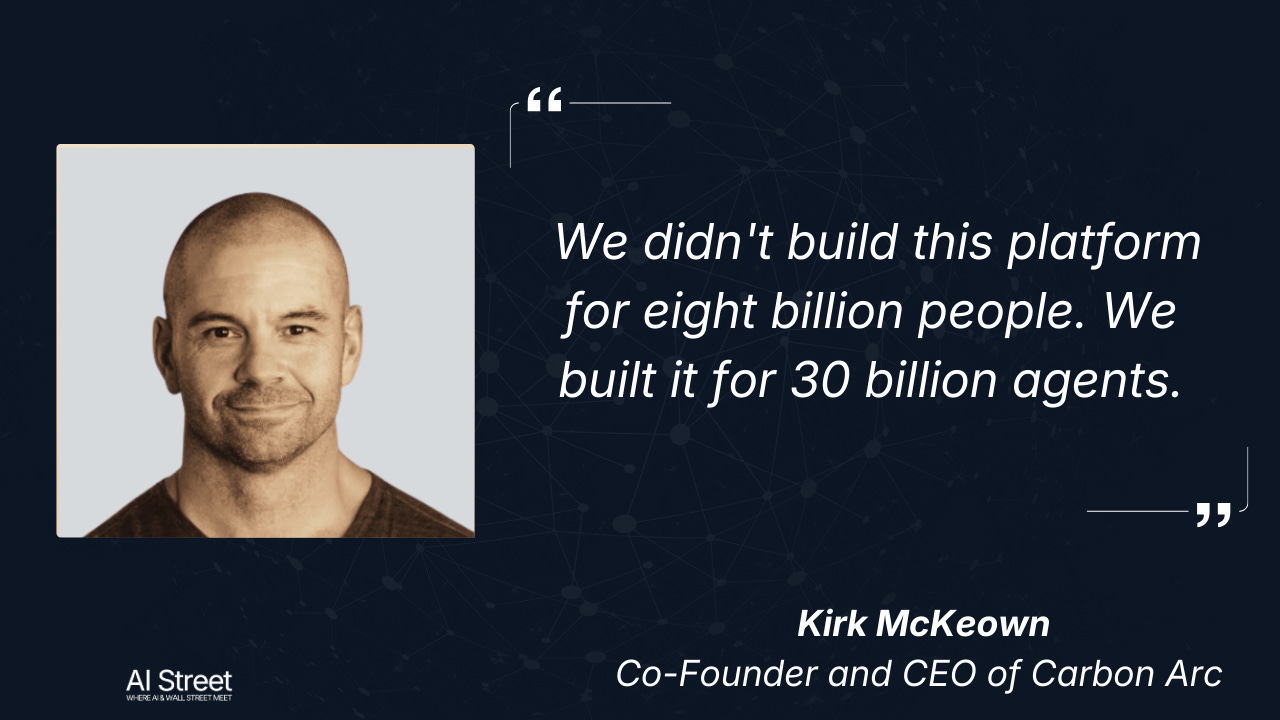
Kirk McKeown spent about 15 years running what he calls the “factory”—some of the largest fundamental channel-check and data driven operations on the Street – first, at Glenview, and later, at SAC Capital and Point72. At its peak, his team was conducting several thousand calls each year. Kirk’s role evolved and ultimately, he ran all proprietary research at Point72 across calls and data. After years of managing this massive human-capital engine, he realized the “moat” in institutional finance was shifting from access to data towards the architecture used to structure it.
In 2021, he co-founded Carbon Arc, a platform built to structure data to be sold by consumption, as opposed to locking it up as a long-term asset. Carbon Arc unlocks data trapped on balance sheets and is fresh off a period of rapid institutional adoption. Now, Carbon Arc is betting that the future of alpha resides in a “refinery” capable of structuring 100 trillion transactions for the coming wave of 30 billion AI agents, solving problems not only on the Street, but for all types of businesses around the world.
I spoke with Kirk about his journey from the “manual” Wall Street factory to Carbon Arc’s “agentic” refinery. Here is what readers will learn:
How the “several thousand calls per year” grind forged a mathematical framework for global market structures.
Why Carbon Arc treats data as a derivative with time decay (Black-Scholes for data).
The transition from “drilling” (data collection) to “refining” (knowledge graphs).
Why the next 12 months belong to “automated agent onboarding” over retail chat.
This interview has been edited for length and clarity.
Matt: You had a long history in the hedge fund industry. What made you decide to jump ship and start something of your own?
Kirk: In 2012, I went to SAC to build what is now called Canvas. I had run a similar business at Glenview Capital, and built a large fundamental research business collecting information in supply chains. From 2006 to 2014, I did thousands of calls a year, myself. That kind of volume created for me strong principles around scaling research problems.
Research frameworks are patterns. The same story happens over and over. What’s happening in the U.S. government right now has happened three or four times. It’s just different names and different clothes. The world follows rules based on market structure, business models, management teams, and personality types.
I started to learn that hospitals and hotels are the same business because they both get paid on length of stay…..
NEWS
Goldman, Man Group Adopt Anthropic
This week, Goldman Sachs and Man Group announced new partnership with Anthropic, highlighting how probabilistic systems like LLMs are being used to run traditionally deterministic workflows.
Goldman is working with Anthropic to build AI agents that automate trade accounting and client onboarding. Embedded engineers are co-developing systems around Anthropic’s Claude model. CIO Marco Argenti told CNBC the agents are already shrinking turnaround times in accounting and compliance.
Man Group announced a new partnership with Anthropic this week that gives the hedge fund access to Claude, as well as embedded Anthropic engineers working alongside its teams.
The deal sits alongside Man Group’s homegrown AlphaGPT platform, which it already uses to test and deploy investment strategies at machine scale.
ICYMI

Man Group is model agnostic. AlphaGPT is not tied to a single provider, and the firm continues to make multiple frontier models available across its internal AI platform, according to a company spokesperson.
Man Group is using Claude AI to quickly analyze massive amounts of financial data, giving their investment teams better insights and more time to focus on high-level strategy.
It wasn’t long ago that LLMs were being mocked for failing to count the number of Rs in “strawberry.” This reminded me of something Jonathan Pelosi, who leads Anthropic’s financial services effort, told me in a Q&A last month:

Related:
Anthropic Releases New Model That’s Adept at Financial Research BBG
NEWS
Wealth Stocks Fall Over AI Disruption Risk
Another week, another somewhat random AI release led to billions in market cap losses.
Financial-technology company Altruist unveiled an AI tool capable of automating personalized tax strategies.
Shares dropped in Charles Schwab, LPL Financial, and Raymond James.
What’s less clear is why this happened now. The core arguments about how AI could affect financial services have not materially changed from last week or last month.
I’m skeptical that this move reflects near-term reality. Financial services are heavily regulated. There are legal, operational, and market-structure constraints on how new systems can be deployed, who they can connect to, and how decisions are made. Those constraints slow change. They do not disappear because the models get better.
Maybe there is a longer-term story here. But the idea that financial services is about to be rapidly disrupted, all at once, does not line up with how this industry actually changes.
And to gut check my thinking, I asked Didier Rodrigues Lopes, CEO and founder of OpenBB, for his thoughts, and he makes a valid point on data:
“I think data businesses are safe. I don't think their distribution via UI is safe because it is too rigid, but I think they are in a strong position to basically increase prices of data + charge agents for consumption and make it up there. The more you are closer to the data, the better - exchanges are literally going to be printing.”
Justin Whitehead, CEO of Pebble Finance, says the market selloff may be directionally right, but off on timing.
“It’s a story that doesn’t play out in a trading day. It’s one that plays out over the next five years.”
ROUNDUP
What Else I’m Reading
The New Office Oddity: Co-Workers Dictating Everything Into AI BBG
Junior Bankers Are Teaching Their Elders How to Use AI BBG
Should Data Appear On Corporate Balance Sheets? Forbes
US companies accused of ‘AI washing’ in citing AI for job losses Guardian
Just 2% of Financial Institutions Report No AI Use Fintech Finance News
Treasury pushing for ‘robust’ use of AI in banking, but in a ‘gradual’ way FedScoop
CALENDAR
Upcoming AI + Finance Conferences
New conferences added in bold.
CDAO Financial Services – Feb. 18–19 • NYC
Data strategy and AI implementation in the financial sector.
AI and Future of Finance Conference – Mar. 19–20 • Atlanta
Georgia Tech event featuring academic and industry leaders like the CEOs of Nasdaq and Snowflake.
Future Alpha – Mar. 31–Apr. 1• NYC
Cross-asset investing summit focused on data-driven strategies, systematic investing, and tech stacks.AI in Finance Summit NY – Apr. 15–16 • NYC
The latest developments and applications of AI in the financial industry.
Momentum AI New York – Apr. 27–28 • NYC
Senior-leader forum on AI implementation across financial services, from operating models to governance and execution.AI in Financial Services – May 14, 2026 • Chicago
Practitioner-heavy conference on building, scaling, and governing AI in regulated financial institutions.AI & RegTech for Financial Services & Insurance – May 20–21 • NYC
Covers AI, regulatory technology, and compliance in finance and insurance.
If you read this far down
Do me a favor and hit reply with the number of your favorite story from today:
AI Boosts Retail Trading Volume
Interview with Kirk McKeown
Goldman, Man Group Adopt Anthropic
Wealth Stocks Fall Over AI Disruption Risk