

Ben McMillan says LLMs have saved his investment firm more than $1 million in operating costs.
The CIO and founder of IDX Advisors says AI has helped cut legal bills, replace outsourced developers, and automate proprietary workflows over the three years since ChatGPT launched in November 2022.
His team comes from a quant and coding background, which made it easier to start experimenting.
The firm, a systematic asset manager focused on risk-managed digital asset strategies, began testing large language models shortly after ChatGPT’s release. One of the first use cases they built was a way for AI to read PDFs, something models couldn’t do three years ago.
What started as a tool for reviewing documents has now grown into a broader internal system for coding, compliance and CRM automation. The firm now runs multiple models on the same task and has them critique each other’s output before a human reviews the results. The same approach has allowed the team to replace an offshore development group and build internal tools that would previously have required outside vendors.
I’d like to think I’m pretty current with the new AI tools trying them myself, but Ben is ahead of me with OpenClaw, which he describes this way:
Think about it like an employee that has its own computer. Here’s the big difference from ChatGPT: it has its own dedicated file system, so it doesn’t forget.
In our chat, Ben explains how the firm structures these AI workflows, the tools it relies on, and where he sees the biggest opportunities for AI in financial services.
He walks through how IDX built an AI-powered paralegal workflow, replaced an offshore development team with coding models, and created internal agents that automatically research and enrich potential clients.
He also explains why he believes persistent systems like OpenClaw could become a core layer of AI infrastructure inside small firms.
One theme that comes up repeatedly is that AI handles much of the grunt work while Ben and his team review and validate the results.
This interview has been edited for clarity and length.
Matt: How did you get started with AI?
Ben: I’ll give you a quick overview from day one of everything we did that was material. I’ll caveat it by saying that myself and the other founders come from a quant hedge fund background. We were coming into this already with some software development capability. We were doing our own APIs and things like that. We had machine learning models predicting Bitcoin prices. There was at least a modicum of technical experience in-house.
When ChatGPT first came out, like everybody else, we thought it was an interesting chatbot that could write poetry or create raps. But instantaneously we started just throwing things at it. A lot of people forget—it wasn’t that long ago—but the original ChatGPT couldn’t read PDFs. So the very first thing we built was a simple PDF reader. That was something we had experience with, because you have to vectorize the data. There’s OCR and all that. We did that specifically for legal. Compliance is expensive, and we’re a small business—a 10-person team with revenue under $3M, which is not low, but we need to save money where we can. Using ChatGPT to basically run our own paralegal department instantaneously cut our legal bills. I did the math: we easily saved a million dollars in legal bills since the launch of LLMs, which is material.
Matt: What were you doing previously, and how did you implement this?
Ben: Previously we had different lawyers for different things: a compliance lawyer, corporate attorneys, and JV lawyers. Everything was a back-and-forth. These are expensive Wall Street lawyers. A perfect example is new LP docs. That should be pretty “control C, control V”—a lot of that is templated. Why are we paying $75,000 for another set of LP docs?
I’ll zoom out and make a meta comment. Yes, AI is going to be disruptive—this is the new industrial revolution. But it’s also going to be hugely democratizing for small businesses. It has been tough to compete, irrespective of industry, as a small business in America for really the last 10 years. This is going to disintermediate massively in favor of small businesses.
Legal is a perfect example. We had a busy year in 2024, and what we did (regarding using LLMs in-house)—we always use a red team, blue team approach. That is the quickest way to dramatically increase the quality of the LLM output.
By giving two different LLMs the same task and have them review each other’s work. Especially when it comes to things like legal. There was that headline early 2023 about a lawyer using ChatGPT to draft a brief in which the LLM massively hallucinated, and we were cognizant of that. So we would have Claude and ChatGPT both review a document, come up with comments, and then have them review each other’s comments. We would take that to our lawyer and say, “This is our comprehensive review.” At that point, they didn’t necessarily know we were using ChatGPT, but I’m sure they were looking at it and saying, “I can’t overcharge for this.” What would have been a 40-hour exercise is now literally a two-hour exercise. We spent $7 in AI compute.
We are basically replacing their paralegal function but not paying for it. We even talked to one group that asked if we could set up a custom LLM in-house for them. People are already seeing the writing on the wall.
Matt: How did this transition into your software development?
Ben: We’re originally a quant fund, so we’ve been developing our own software for internal use for years. For things like Python or SQL database software, we’re experts. Where we were paying for heavy dev work was on anything on the front end. We wanted to create business intelligence dashboards so the whole firm could see our machine learning Bitcoin model outputs—not just me and the research team that can run Python on our computers. The problem is, when you get into front-end UIs—TypeScript, React—that might as well be hieroglyphs to us.
In Q1 2023, we had a full offshore outsource dev team—one of these software teams offshore—and we were spending easily up to five figures a month on these guys. They were good. They built us internal dashboards, took a lot of our Python scripts, and turned them into real software we used internally.
I started popping things into ChatGPT. I would prompt it and say, “You are a Chief Technology Officer supporting me, the CEO of a quantitative hedge fund.” Those long, specific prompts really help. It could take Python code and help with the front end. It would say, “Go to Vercel, spin this up, go to GitHub,” and we would have a UI push.
Fast forward through different iterations—Gemini, Claude Code—and that same offshore team eventually called us asking what the next project was. I told them we had taken it in-house. They asked how, and I said Claude Code. We run red team, blue team, so we’re running Codex and Claude Code simultaneously and having them check each other’s work. There was silence on the other end of the line.
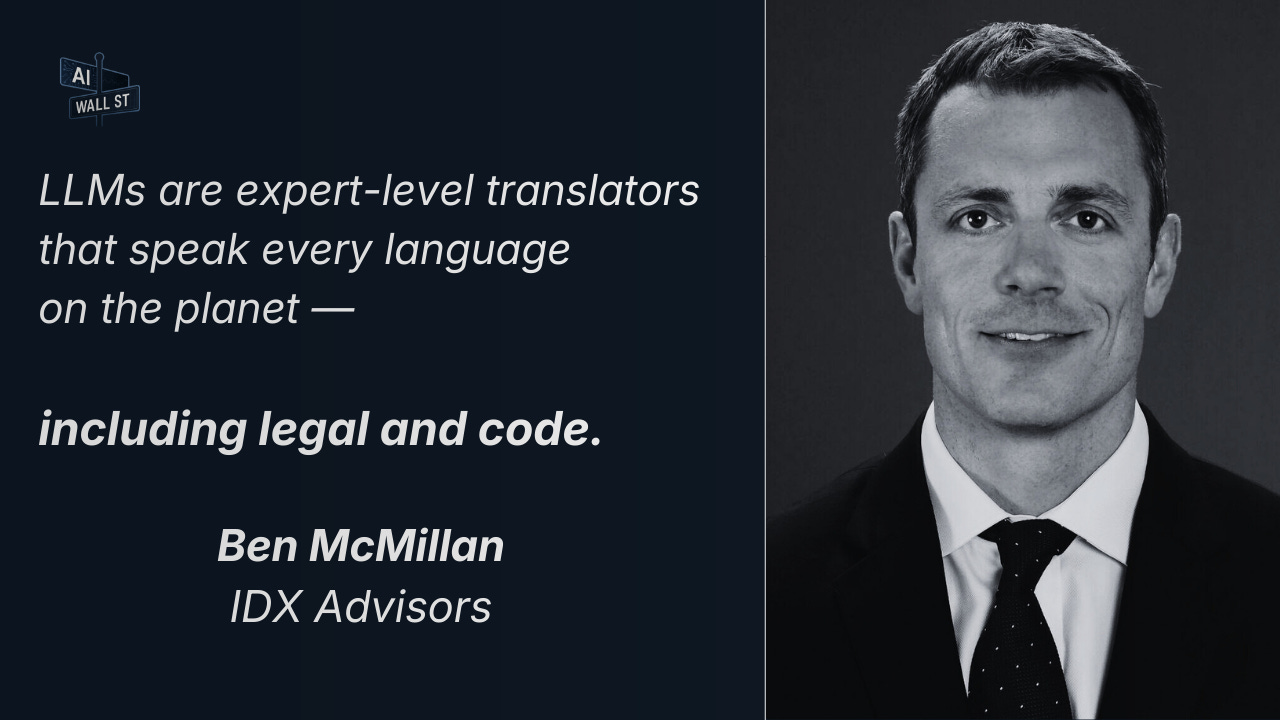
What you come to realize is that in software, the expensive part is yes, the engineers, but there is also the cost of time. What’s nice about having embedded LLM functionality—on the legal side or the code side—is the feedback loop is virtually instantaneous. The software development cycle rapidly accelerates and it’s cheaper. I didn’t have to go back and forth on Slack or explain the logic to these guys. The LLM understands that perfectly, especially the latest versions, because they’ve got very high-functioning reasoning. LLMs are expert-level translators that speak every language on the planet, including legal and code. Up until now we’ve had to pay a lot of money for human translators in those domains, and that has just been ripped away.
Matt: You mentioned automating your lead enrichment and CRM. How did that work?
Ben: We have a lean, mean sales team. We’re quants, so we’re very big on data enrichment and digital outreach. Everything has to be run through compliance. We were looking at Salesforce and thinking about how to automate lead QA. We don’t necessarily want a junior person doing that because it’s a waste of their time—and it’s not simple QA. What we want is an agent that can look at the firm that clicked on our email, go to their website and find out who they are, then go to their SEC ADV filing—which is a public filing showing their lines of business and what type of advisor they are. We would also have the agent look at the website’s “About Us” section for anything related to golf or sailing to help enrich the conversation. We wanted all of this to be part of a lead enrichment cycle.
