

Hey, I’m Matt. I’m a former Bloomberg News reporter, and you’re reading AI Street, where I report on how Wall Street uses AI.
Virtually all of the major hedge funds have been building AI into their workflows.
Citadel has an AI assistant
Man Group has AlphaGPT
Bridgewater has an AI fund generating “unique alpha”
AQR’s Asness says AI has become “annoyingly better”
There are more but you get the idea.
The science-fiction way to think about AI in finance is that all these funds are building Minority Report systems, where soothsayers predict the next market event. The reality is more prosaic. They’re building systems that amplify their investing point of view. Like, as we discussed last week, how Bridgewater worked with Thinking Machines to create a model that better combed through relevant investment news and research.
Investors can’t build everything themselves (nor do they have the budget of Bridgewater) so there's an emerging niche of companies building AI & investing functionality by alums of larger firms. From Business Insider:
Ian McInnis, a former Bridgewater analyst, founded WithAI, a Y Combinator-backed startup helping funds use LLMs to process information and plug AI into the investment process.
Jaime Villa, previously a macro researcher at Schonfeld and Citadel Securities, cofounded Macro Technologies, which is trying to automate repeatable work done by macro analysts.
Cameron McKendrick, a former Jain Global executive, leads Serona Data, which looks for investment signals in healthcare data.
While the BI story suggests these upstarts could eventually mean fewer analyst jobs, I don’t subscribe to this idea. None of the folks I’ve talked to have said AI is leading to fewer jobs. AI creates more work. Cheaper tools mean more stocks to screen, more signals to test, more AI-generated claims to verify and on and on.
SPONSOR
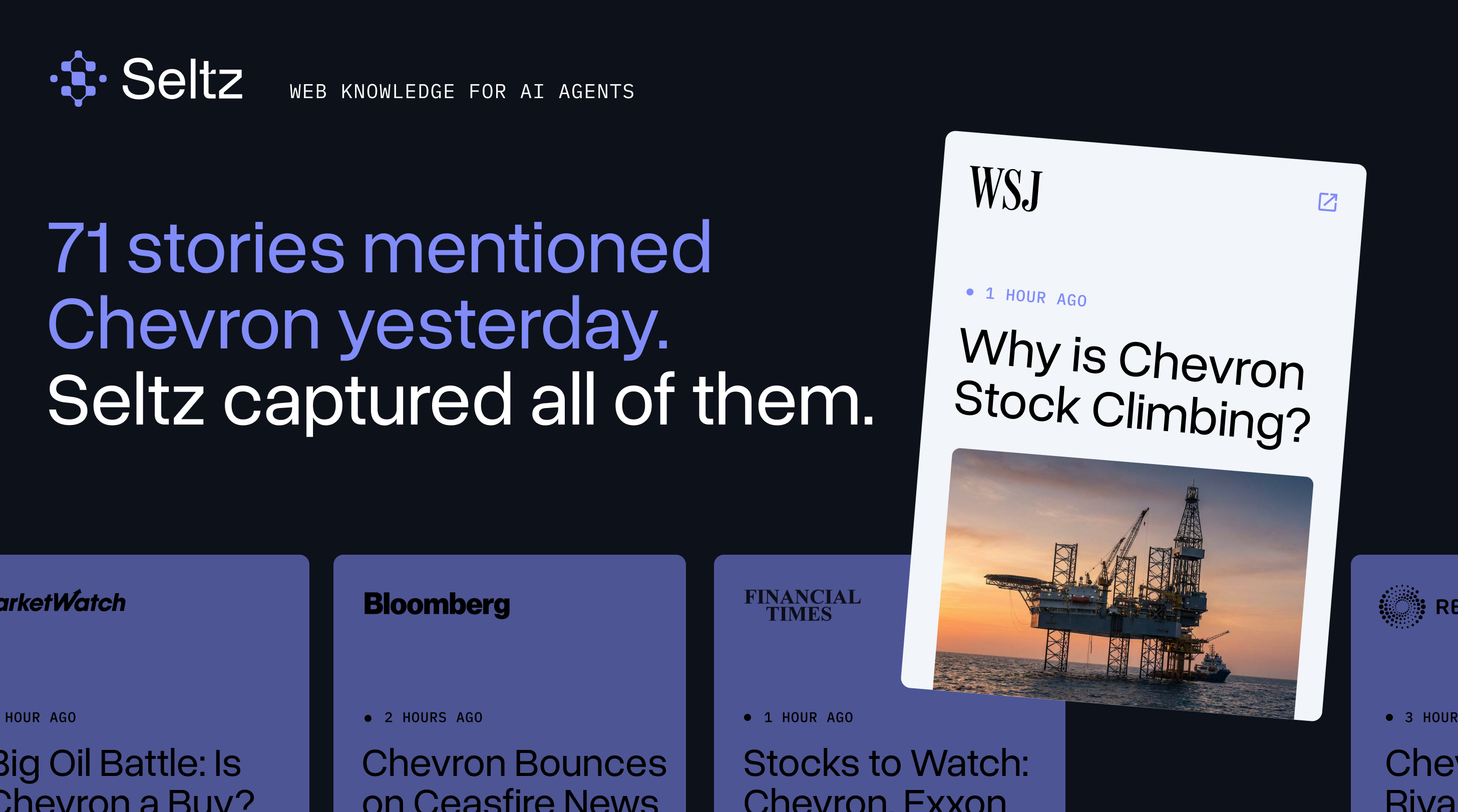
The Brent-above-$80 headline was in all the feeds. The drone strike on a Chevron-chartered tanker off Novorossiysk, the shale-recovery tech deal with ZL Chemicals, and California’s gas-price fight were in the maritime and energy trade press — the physical signal, scattered across outlets no single feed carries.
Seltz returns all of it, raw. Full articles, first-person reporting, within the hour of publication. No summaries, no sentiment scores – your models do the distillation better than any vendor, on input nothing has influenced.
Search any name across any day in history the same way. That’s how teams build and test a signal before they trade it live. Backed by B Capital and Speedinvest.
Want the full picture on every name you trade? Book a demo — bring 10 questions your desk actually asks, and we’ll run them live.
The FCA Takes Up Chatbot Financial Advice
While the SEC has been pretty quiet on AI financial advice, the UK’s FCA released a report this week saying consumers are already using general-purpose AI tools for money questions without understanding that regulated-advice protections may not apply.
The FCA surveyed 5,026 UK retail-finance consumers in April. Sixty-seven percent said they use AI; 16% said they had used it for financial tasks. About 26% said tools like ChatGPT provide reliable financial information or advice. Only 40% understood there would be no formal route for recourse if that advice went wrong.
The FCA is not proposing chatbot rules yet. It wants to know whether general-purpose AI tools are already giving advice-like support outside the regulatory perimeter, and whether existing rules on advice, promotions and arranging still work when the first intermediary is a chat interface.


AI as Deal Runner
So far, AI in finance has mostly lived in the back office: KYC checks, code help, earnings call summaries, etc. But this is the first I’ve heard of AI running a deal. From the WSJ:
When the buyout giant CVC put a Greek e-commerce business called Skroutz up for sale earlier this year, it didn’t use investment bankers to run the process. It used artificial intelligence.
Prospective buyers of the company were sent a link to a data portal that acted like an investment memo. A chatbot “analyst” acted like the banker, answering questions on financials and due diligence or prompting interested parties to get in touch with the management team for a further discussion.
The CEO of Skroutz spearheaded the company’s AI exit, so this is an unusual test case, but I suspect not the last one we’ll see. Blackstone agreed to buy the Greek e-commerce business in May.
Your AI Avatar Money Manager
I was talking with a friend who said they liked the “vibe” of Claude over ChatGPT, which made me think we’re on our way to having “relationships” with our favorite chatbot. This would have sounded weird and creepy, maybe, two years ago? Less so now.
Companies are leaning into avatars.
OCBC, a Singaporean bank, is rolling out two avatars, Wendy and Wayne, for wealth clients with more than S$1.5 million in the bank. They can answer questions about markets, portfolio news and customer holdings, pulling from real-time market data, OCBC research, client portfolios, transactions and behavioral signals.
The avatars pull from approved data, hard rules limit what they can answer, and separate agents handle different types of requests. If Wendy or Wayne reaches the edge of what they are allowed to do, the conversation goes back to a human relationship manager.

ROUNDUP
What Else I’m Reading
Don’t rely on AI for personal finance advice, study finds | CNBC
Singaporean regulator outlines safety guardrails for financial AI agents | Yahoo
Using AI to Let History Speak About Bank Runs | NYFed
Databento raises $97M Series B led by NEA | Utah Business
This just came out, so I haven’t had a chance to listen yet: Man Group on Odds Lots:
This Week in AI Street
The Rise of the House Model

Travelers is the latest large company to train an AI model on its own data and says it beat commercially available systems.
The insurer trained TravelersLLM on millions of internal documents for underwriting, research and model development, according to a June 30 press release. The company, founded in 1864, said its long history and proprietary data helped improve the model’s precision.
Investors managing billions in assets read AI Street.
Paid subscribers access original reporting, data analysis, and interviews with the executives and researchers leading Wall Street’s AI buildout.
Consider expensing AI Street. If it helps you evaluate one AI initiative, pressure-test one vendor pitch or understand one real deployment constraint earlier, it more than pays for itself. I put together a short template you can send your manager.
SPONSORSHIPS
Reach Wall Street’s AI Decision-Makers
AI Street reaches institutional investors, C-suite executives and Big Law attorneys at firms including JPMorgan, Citadel, BlackRock, Skadden, McKinsey, and more. Sponsorships are reserved for companies in AI, markets, and finance. Email sponsors@ai-street.co for more details.
CALENDAR
Upcoming AI + Finance Conferences
Global Agentic Regulator Hackathon – July 8–September 18 • Online
Hackathon for building agentic tools for public authorities, focused on AI advice, market manipulation, payments, decentralized infrastructure, and scams.
ARPM Quant Bootcamp – July 13–16 • New York
Four-day quant workshop from ARPM, focused on portfolio construction, risk, machine learning and the plumbing behind systematic investing.
Artificial Intelligence for Financial Services – July 23–24 • Cambridge, MA
MIT executive-education workshop on AI/ML applications in financial services, emphasizing strategy, use cases, and implementation considerations.
Thanks for reading!
I’m always happy to receive comments, questions, and feedback.
Connect with me on LinkedIn, or
Send an email to matt [at] ai-street.co
The workflow-automation angle has a second-order effect worth watching. A human research desk draws compute in lumps, hard to forecast and easy to defer, but a fleet of always-on agents running a known cadence turns that into a predictable, schedulable baseline load. You cannot write a forward on lumpy human demand, yet a standing agent workload is exactly the kind of thing you can term out, so the quiet consequence of automating the desk is that it makes the compute underneath forward-priceable for the first time.