

Hey, I’m Matt. I’m a former Bloomberg News reporter, and you’re reading AI Street, where I report on how Wall Street uses AI.
The way hedge funds use AI fits into two broad buckets.
One way is to train an AI model on market data. In other words, instead of training one on language, you gather all the financial market data you can get your hands on, train the model—not to predict the next word—but the next market event. This is hard and expensive. Firms like Hudson River Trading and XTX are spending billions of dollars to build their own data centers. (And in the case of HRT, putting out movie-quality videos of their GPU clusters deep inside a Norwegian mountain.)
The second way is leveraging large language models and building skills and systems around them. This is what Man Group has done, I’m oversimplifying a bit, with its AlphaGPT. For more on that, check out my interview with Man Group’s Ziang Fang:

While LLMs are solving 80-year-old unsolved math problems, they sometimes struggle with the nuances of what an investor cares about. You can try to prompt it: “You’re a macro investor at a multi-strat hedge fund.” But that only gets you so far.
To teach a model more of that investor judgment, Bridgewater fine-tuned an open-weight model on examples labeled and reviewed by its investment experts, according to a statement this week from the hedge fund and Thinking Machines, the AI startup run by former OpenAI CTO Mira Murati. The goal was to teach the model what Bridgewater investors would consider relevant.
For example, virtually no investor reads all of a company’s disclosures. They’re hundreds of pages long. Humans skip boilerplate language. LLMs often treat that text equally so even with a very large context window — basically AI’s working memory — they still get lost. It’s just too much information.
Bridgewater and Thinking Machines turned that skipping into training data. They trained the model on six versions of the same basic problem: deciding whether a financial article, central bank document or research report was relevant, and where the useful part of a document or email ended and the boilerplate began. When the model disagreed with the original labels, those examples were sent back to Bridgewater experts to make the distinction clear.
The result was a model that beat the frontier models Bridgewater tested. With expert prompts, GPT, Claude and Gemini got into the mid-to-high 70s on the six tasks. Bridgewater’s fine-tuned model reached 84.7% average accuracy, which the firm said was good enough for daily use, and cost 13.8 times less per task to run.
When you’re running AI scale, costs add up quickly. We talked about how AI costs can balloon because of untamed AI last week. Firms are spending tens of millions of dollars on research tasks that may not be necessary.
A person familiar with Bridgewater’s AI efforts said this research on improving efficiency is a small piece of the hedge fund’s broader goal of building a complete “AI investor” that can match and exceed their human counterparts.
The system combines Bridgewater’s proprietary causal time-series machine learning with custom LLM systems, including specialized models and frontier models adapted with the firm’s own harnesses and agent-style workflows, the person said. Bridgewater sees specialized models as an important part of that effort.
Bridgewater formed its Artificial Investment Associate (AIA) Labs division in 2023 to build investment systems that combine large language models, machine learning, and reasoning tools. Its AIA Labs Macro Strategy, live since December 2023, is generating market-beating returns and now has more than $4.5 billion in assets.


Lawmakers Press SEC on AI Agents in Retail Trading
Democratic lawmakers are pressing the SEC on the risks posed by agentic trading, including whether brokerages, AI providers or investors themselves are liable when a retail investor lets an AI agent give advice, place trades or take other actions inside an account.
In a June 23 letter to SEC Chair Paul Atkins, the lawmakers asked whether the agency has discussed AI-agent use with broker-dealers, whether it plans to issue guidance, and what guardrails brokerages should have in place before letting agents act for customers, according to Advisor Hub.
Robinhood and Public allow retail investors to connect AI agents to their brokerage accounts: Robinhood has promoted AI stock-trading tools, while Public advertises agents that can run covered-call strategies and same-day options trades tied to intraday S&P 500 moves.
Across the pond:
BoE Says Existing Rules Weren’t Built for AI Agents
Bank of England Deputy Governor Sarah Breeden said current supervisory frameworks were not designed for autonomous agents in payments and trading, where human approval for every action may not be realistic. She pointed to scenario analysis, AI-enabled monitoring, digital twins, enhanced recovery for core systems, and kill switches or circuit breakers for faulty trading models.
Fundraising and Partnership News
Arca, which uses AI to support financial advisors, has raised $64 million across seed and Series A funding rounds. General Catalyst led the company’s $48.5 million Series A, with backing from Index Ventures and Venrock. Arca said it manages more than $1 billion in client assets. More on Arca here:
MDOTM raised $27 million to expand Sphere, its AI platform for asset and wealth managers. The company says Sphere supports more than $100 billion across 60-plus financial institutions and is used for investment insights, portfolio construction, rebalancing and client reporting at scale. For more on MDOTM, check out my interview with Peter Zangari, a partner at the firm.
LinqAlpha raised $22 million in Series A to expand its AI-agent platform for institutional public-markets research. The company says more than 70 financial institutions use its tools, including buy-side clients managing over $5 trillion, and plans to use the funding for hiring, data integrations and broader deployment across asset classes.
FactSet is partnering with and investing in TIFIN.AI to add AI agents to wealth-management workflows. The first tools focus on meeting prep and book-of-business intelligence, with the pitch centered on helping advisors personalize service at scale while keeping client data inside FactSet’s infrastructure.


What Else I’m Reading
Millennium Builds AI Lab in Push for Cutting-Edge Products | BBG
Now hedge fund Qube Research and Technologies is building out a “lab” too | eFinancialCareers
Wall Street’s AI Race Is Fueling New Fears of Crowded Trading | BBG
Hedge funds offer bumper pay to lure AI talent: ‘Million-dollar packages are not far’ | Financial News
Is AI Good at Stock-Market Timing? A New Study Casts Doubt | WSJ
Investors managing billions in assets read AI Street.
Paid subscribers access original reporting, data analysis, and interviews with the executives and researchers leading Wall Street’s AI buildout.
Help Benchmark AI Adoption in Finance
It’s hard to get reliable data on how AI is actually being used by financial firms.
Neudata, a data scouting service for the financial services industry, is running a short survey on how the sector works with alternative data, market data and AI.
It takes about 5 minutes. Participants gain access to the results from data buyers as well as vendors, plus a chance to win a $500 gift card.
Topics include data budgets, in-demand data categories, and the AI models used to process that data.
This Week in AI Street
Three Ways Investors Are Using AI Now

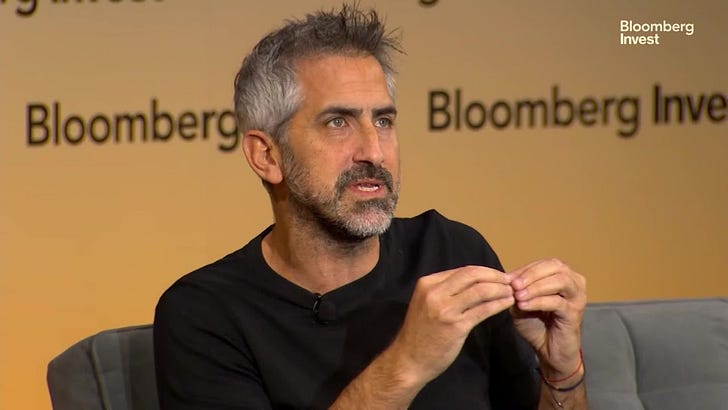
Regenstein is a former attorney and self-taught coder who now leads wealth and asset management at Snowflake, where he works with banks, hedge funds and asset managers building AI systems on top of their own data. Snowflake does not build frontier models. It works with providers and platforms including OpenAI, Anthropic, Mistral, Meta and Hugging Face, which gives Regenstein a view into how firms are putting different models into production and where they still struggle.
He says investors are using AI in three main ways:
1. Chat: using the model conversationally to test a hypothesis or get a first read on what’s happening.
2. Text analytics: “Go examine this 10-K for me” — or, at asset-manager scale, turning years of filings, research papers, and sell-side research into an “engine of insights.”
3. Coding assistant: “Write the code for me” — helping quants and investors code up hypotheses, reproduce papers, build dashboards, or call validated models.
CALENDAR
Upcoming AI + Finance Conferences
The Fin AI Symposium 2026 – July 3 • San Diego
Industry symposium focused on applied AI in finance, with practitioners sharing tooling, workflows, and deployment lessons.
ARPM Quant Bootcamp – July 13–16 • New York
Four-day quant workshop from ARPM, focused on portfolio construction, risk, machine learning and the plumbing behind systematic investing.
Artificial Intelligence for Financial Services – July 23–24 • Cambridge, MA
MIT executive-education workshop on AI/ML applications in financial services, emphasizing strategy, use cases, and implementation considerations.
Thanks for reading!
I’m always happy to receive comments, questions, and feedback.
Connect with me on LinkedIn, or
Send an email to matt [at] ai-street.co
The training methodology is more interesting than the result. They didn't teach the model what to read. They taught it what to skip. The expert judgment they captured wasn't "this paragraph matters." It was "these 200 pages don't." That's the knowledge that can't be prompted. You can tell a frontier model to act like a macro investor. You can't tell it which 80% of a 10-K is boilerplate without already knowing yourself.
The cost number is the one that matters at scale. 13.8x cheaper per task turns AI from an experiment into infrastructure. At Bridgewater's query volume, the difference between frontier pricing and fine-tuned pricing is probably eight figures annually. That's the gap between "we're exploring AI" and "AI is in the production stack." Most firms are stuck on the wrong side of that gap because they're paying frontier prices for tasks that don't need frontier capability.
Next market event predictions from AI will have about the same accuracy as humans because...AI is simply regurgitating data and biases fed by humans. Am I missing something? Or has Bridgewater discovered AGI before the labs?