

Hey, I’m Matt. I’m a former Bloomberg News reporter, and you’re reading AI Street, where I report on how Wall Street uses AI.
If you’re a '90s kid like me, you remember buying CDs at Circuit City. You couldn’t buy individual tracks online, so you had to buy the whole album for the one or two songs you wanted.
Technology eventually unbundled music. Now it is beginning to do the same to financial data.
Traditionally, an equities trader who needed data for only a handful of stocks might still have to license an exchange’s entire market-data feed.
This problem was the genesis of Databento, which lets customers buy specific market data and pay based on usage.
Christina Qi co-founded the Utah-based company after seeing the challenges of acquiring market data while running a high-frequency trading hedge fund. Founded in 2019, Databento announced last week that it raised a $97 million Series B led by NEA with participation from DRW Venture Capital, Redpoint Ventures and Tribe Capital.
Qi has leveraged her HFT background at Databento by placing the company’s servers in the same data centers as exchanges to receive their market feeds directly. The company processes market data into standardized formats and sells real-time and historical data for equities, futures and options through APIs. With the new funding, the company plans to expand to more than 20 data centers worldwide and has secured more than 100 petabytes of storage capacity to support that growth.
I recently spoke with Christina about how technology is disaggregating market data, a shift I’ve been covering (see my interview with Carbon Arc CEO Kirk McKeown and Aiera COO Gavin Skinner). Qi and I discuss fundraising in an AI-obsessed VC environment, why AI labs are buying market data, the complexity of exchange licensing and how usage-based pricing can create problems for large firms.
This interview has been edited and condensed for clarity.
Seems like venture capital investors are focused on backing AI companies right now. What was it like raising in this environment?
Christina: We are actually one of the few non-AI companies to raise a round of this size, which is quite unusual in the current market environment. While many non-AI companies face pressure to position themselves as AI businesses, we have never felt that pressure. We got this far by being hyper-focused on what we are good at, which is data. We choose not to compete against our customers, who excel at AI. Instead, we stick to our strengths to support them.
Market data has typically been sold in bundles. Why do you sell it a la carte?
Christina: We are the first company to bring what is called usage-based pricing to this industry, meaning instead of paying for the entire exchange—like buying the entire grocery store—you can browse items, taste samples, and buy a bento box for dinner. This allows individuals and teams the freedom and flexibility to shop around before committing to larger datasets.
It is also product-led growth in the sense that customers can self-service and sign up on their own. They do not need to talk to a salesperson. All the pricing is online: here is the price, here is what you get, register, and check out.
More AI Street Expert Interviews


Companies like Carbon Arc offer alternative data on an a la carte basis. Do you see other companies in the data space moving toward this model, and is this the future of the industry?
Christina: There are many incredible startups in our space executing different applications. But it’s worth mentioning that a la carte pricing only scales to a certain extent. Large customers, such as banks and consulting firms, have a fixed budget for data, which works better with annual, flat-rate pricing. Usage-based pricing works great for early-stage experimentation, but can cause administrative headaches down the road.
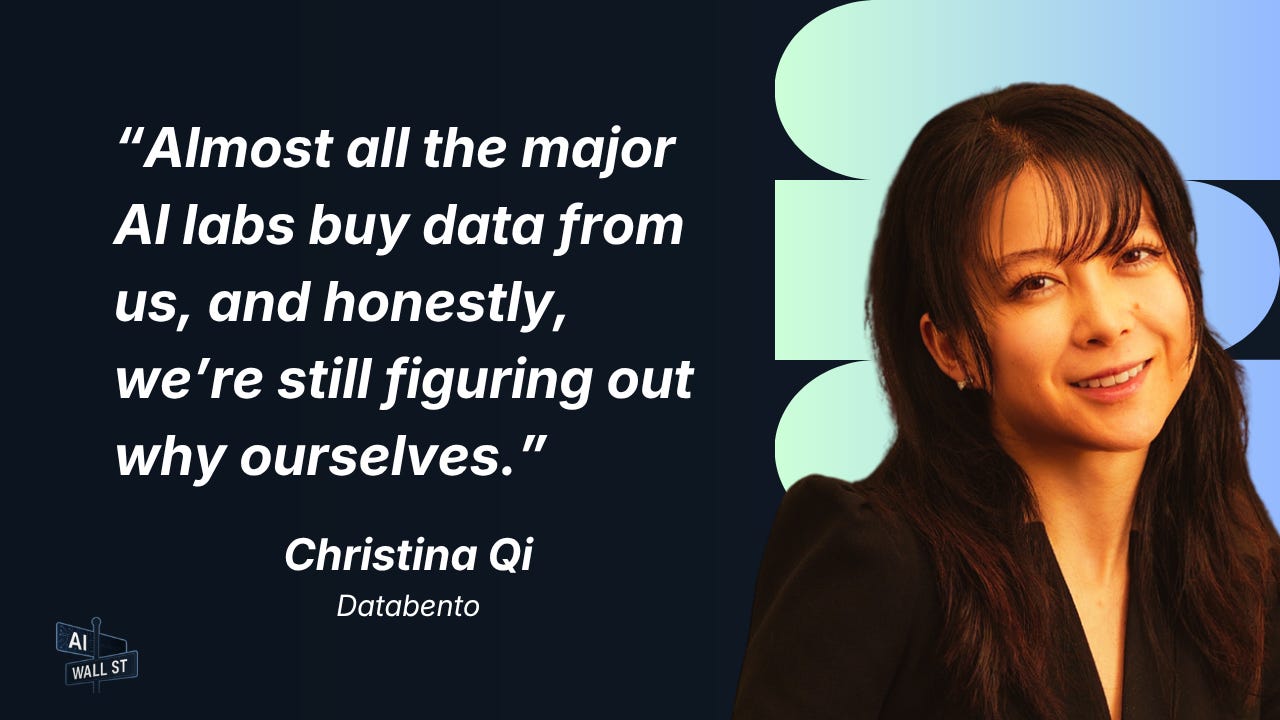
You mentioned previously that major AI labs are buying data from Databento. What are their primary use cases?