

Hey, it’s Matt. I’m a former Bloomberg News reporter, and you’re reading AI Street Interviews, a series on how investors use AI.
The Federal Reserve’s interest rate decision is among the most well-known, market-moving government release. Each statement is instantly parsed by newswires, redline tools, and analysts looking for tiny shifts in language.
Smaller, less-liquid markets have historically lacked that kind of infrastructure. Why invest heavily in technology to trade small markets, like orange juice futures? Trading ends up choppy and concentrated among a few dominant players.
Advances in AI may help narrow that gap by lowering the cost of processing market-moving information and building custom software around smaller, more specialized datasets. One firm trying to build around that idea is Moreton Capital Partners, a systematic commodities investment manager founded by Les Finemore and Alistair Fullerton.
The two were previously at Farrer, a commodities hedge fund that launched in 2024 with backing from Millennium Management. The investment firm redeemed after a second-quarter 2025 drawdown in Farrer’s fundamental portfolio, ending an exclusivity arrangement, according to Finemore. He said the redemption allowed him and Fullerton to launch Moreton for other clients.
The firm has raised about $100 million through separately managed accounts, with plans to top $500 million by year-end and reach $1 billion by next spring, according to a representative. Trading in the SMA accounts began a few weeks ago, so performance data is limited. Moreton has also been producing trade ideas for a multi-strategy hedge fund.
MORE AI STREET INTERVIEWS


I spoke with Finemore about why he thinks AI can give commodities investors an edge. He pointed to the USDA’s monthly World Agricultural Supply and Demand Estimates report, known as WASDE. Released in the middle of the trading day, the roughly 40-page report includes detailed forecasts for crops including oilseeds, cotton, sugar and poultry —too dense a document for a human to digest quickly.
Finemore said Moreton’s system spotted an opportunity in wheat after the May WASDE report.
“We could quickly determine: ‘This is a big miss on production. This is bullish.’ Wheat then went limit up. There was still time to position.”
In our conversation, we discuss:
How Moreton is trying to systematize fundamental commodities trading across 100+ markets.
Why Finemore says commodity trading still relies on manual work, physical-market knowledge and fragmented data.
How the firm uses LLMs to test trading ideas, write code, find replacement datasets and interpret model outputs.
Why Moreton built its own risk platform, and how it wants the system to explain portfolio moves through Slack and a web interface.
Why Finemore thinks portfolio managers at multi-strategy funds may not have the time or incentive to build unproven AI infrastructure.
This interview has been edited for length and clarity.
Matt: When you say you are using AI to invest in commodities, what does that mean exactly?
Les: We are forecasting more than 100 commodity markets. We trade metals, energy, agricultural commodities and soft commodities, including markets in China through swaps.
Most of our trading happens on a weekly basis, when we rebalance the book. We are market neutral. We look more like a long-short equity fund than a concentrated commodity manager.
We think about it as systematizing the fundamental trader. Traditional quants often focus on price, volume and momentum. We use a lot of fundamental data: weather, physical-market prices, basis differentials at the interior and export levels, landed cost-and-freight prices, satellite data and shipping data. We also use options, flow and macro data.
We have more than 250,000 datasets with many features. A human trader may only be able to cover five markets closely in a day. We are trying to look across many markets while retaining that fundamental detail.
Matt: What does AI let you do in commodity markets that you couldn’t do before?
Les: May’s WASDE report was our first proof of concept trading the release this way. We fed in market-survey data, positioning and the price drift before the report. Then wheat production came in with a big surprise.
We could quickly determine: ‘This is a big miss on production. This is bullish.” Wheat then went limit up. There was still time to position.
That is where we see an edge: finding inefficiencies in smaller markets that not everyone is watching and analyzing the release inside a window that would previously have been too short.
At a previous firm, a trader would print the WASDE report, underline it and perhaps trade 45 minutes later. That workflow is too slow now.
Matt: There’s been a lot of growth in systematic strategies in stocks. What’s the trend in commodities?
Les: Commodity trading is still very manual. I started exporting grain from Western Australia and later traded at Merricks Capital, where a four-person investment team covered more than 30 markets.
We traded fundamental dislocations across commodities and calendar spreads. The fund performed relatively well, but the process was not very repeatable. A lot of the work could be automated: gather the information, narrow it down for the trader and systematize how the balance sheet is deployed.
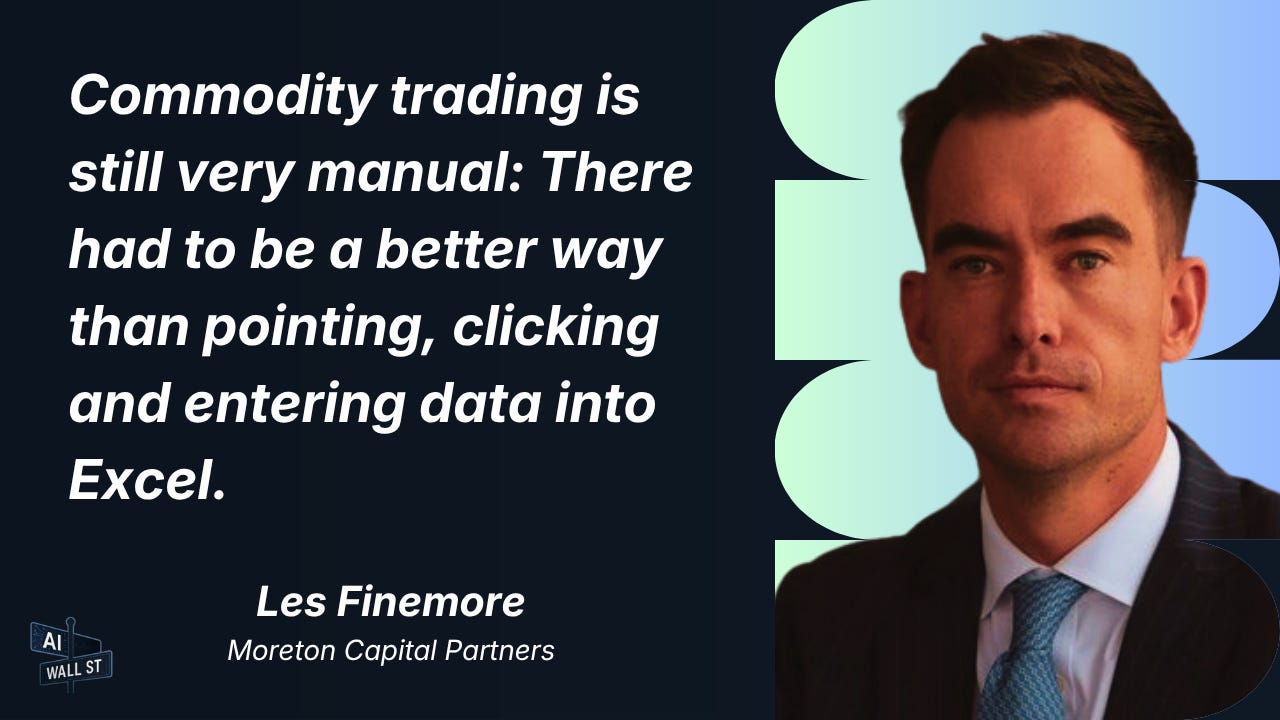
When you cover 30 markets, it is hard to know each one intimately and consistently find an edge. I came away thinking there had to be a better process than pointing, clicking and entering data into Excel.
Matt: How do you use LLMs?
Les: We are trying to use them at each step of a traditional quant’s workflow.
We did natural-language processing in 2017 and 2018, but it was a very naive approach. Now, LLMs make it much easier to take unstructured data and factor it into models quickly.
Every day, we scrape academic articles and blogs looking for potential signals. If an academic is writing about an idea, it is probably already saturated, but it can still give us something to build on. An LLM can help write the code needed to test the hypothesis and build a model around it.
Agents can also search for potential data sources. They can identify a dataset that has been deprecated and suggest a replacement, or find a new dataset that looks different from what we already have.
Then there is interpretability. At Imbue, we had thousands of model outputs and struggled with how to interpret them. We now use LLMs over those results.
Everything is trying to augment the human.
Matt: Are the LLMs producing trading signals?