

Hey, it’s Matt. You’re reading AI Street, where I report on how Wall Street uses AI.
INTERVIEW
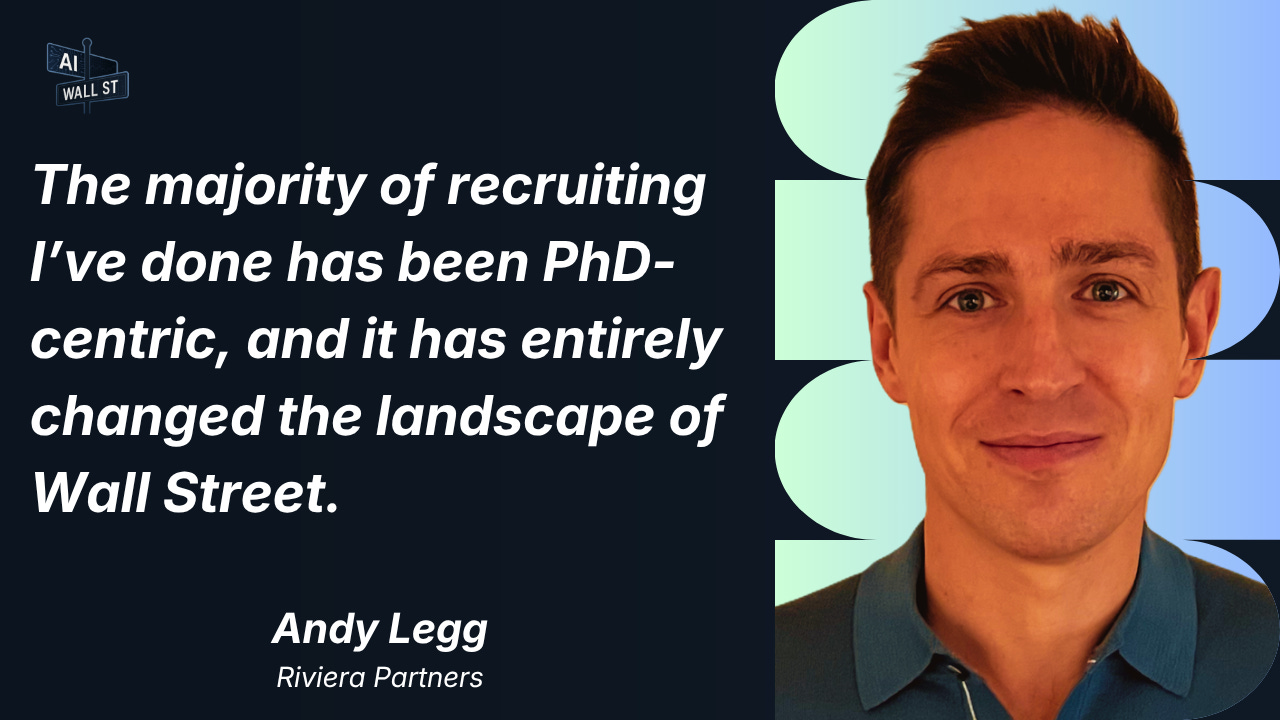
Andy Legg has recruited for Citadel, Point72, AQR Capital Management and Two Sigma, helping drive Wall Street’s shift toward quant strategies and PhD-led teams.
Now, he’s hiring for the next phase: AI.
In a recent interview, Andy, now a Director at Riviera Partners, discusses how hiring became “PhD-centric” after the financial crisis, how the high cost of computing power is limiting who can build AI systems, and how at least one hedge fund is letting those systems make trading decisions.
PhD Hiring Took Hold After the Financial Crisis
“I started in quant recruiting in 2009, just after the crash. The majority of recruiting I’ve done ever since has been PhD-centric, and it has entirely changed the landscape of Wall Street.”
A Hedge Fund Using AI as Trader
“The most advanced AI in trading capability I’m aware of is a particular hedge fund where the AI is the trader. The researchers and engineers are feeding the reasoning engine of this AI daily to make better trading decisions, but the AI is making the trading decisions.”
Private Equity Is Running Into a Data Problem
“They [Private Equity firms] are realizing the quality of their data in terms of validation, alternative data, and structured versus unstructured data is not where it needs to be to run AI, let alone prediction or recommendation systems.”
The Seven-Figure Talent War
“Candidates in the R&D spectrum who have a CS/Stats/ML/AI PhD under a renowned professor, published relevant papers at leading conferences... can command north of seven figure total comp packages at a pretty young age.
The “Vibe Coding” Interview
“An increasing number of funds are changing their approach to acknowledge those that can use prompt engineering or vibe coding effectively. The onus is increasing now on asking what AI tools you use and how AI-savvy you are.”
This interview has been edited for clarity and length.
Matt: I feel like the image of Wall Street is still the “Masters of the Universe” type, but it’s become way more PhD-driven now.
Andy: It’s funny when you talk to people removed from finance; they think of the New York Stock Exchange and people being there Eddie Murphy-style, like in Trading Places or Wall Street, thinking everyone is still wearing suits and ties. It’s anything but that these days. Everything is algorithm-driven and automated. The difference now is the compute… very few AI startups-mid size tech firms can afford to train their own models because they haven’t got the money to pay NVIDIA for the compute.
I started in quant recruiting in 2009, just after the crash. The majority of recruiting I’ve done ever since has been PhD-centric, and it has entirely changed the landscape of Wall Street.
Matt: It seems like it’s going to be more and more that way. The OTC markets have basically been the barrier, but now if you can structure all this data, it changes things.
Andy: This evolution is no longer limited to the upper echelons of finance. We are seeing that now in private equity. The data drive we witnessed in quant maybe ten years ago—where big data providers started popping up—is now increasingly happening in PE because they want to do AI to benefit from operational efficiency. They are realizing the quality of their data in terms of validation, alternative data, and structured versus unstructured data is not where it needs to be to run AI, let alone prediction or recommendation systems.
Matt: AI has been around for a while, but LLMs have made it “AI” in the way people talk about it now. When did it start to shift recruiting-wise?
Andy: Machine Learning has been around for more than 40 years. The difference now is the compute and the scale at which it can be performed.
I placed my first machine learning research engineer at a hedge fund in 2013. If you look at some of the more illustrious quant hedge funds— Renaissance Technologies, D.E. Shaw, TGS —they were leveraging ML in the late 90s and early 2000s. G-Research is another where their ML quant group was started in the early 2010s and seeking to incorporate ML into their trading strategies.
If you watch the show Billions, which is primarily based on Point72, they do a good job of parodying elements of the market adoption and certain innovations. One of the more renowned data science to market intelligence stories of the 2010’s is about a lumber strike in Canada. The fund in question flew drones and used satellite imagery to figure out when the strike was going to end and how much lumber was piling up. These insights informed their trading strategies and its rumored they made millions of dollars in profit from this in a matter of days. Now in the 2020s, most quant funds are combining the insights data science has provided them with AI, whether gen-AI and/or agentic AI to find greater opportunities to beat the markets.
The most advanced AI in trading capability I’m aware of is a particular hedge fund where the AI is the trader. The researchers and engineers are feeding the reasoning engine of this AI daily to make better trading decisions, but the AI is making the trading decisions. This business is doing very well thus far. News broke recently that Instacart co-founder Apoorva Mehta is launching a new hedge fund, Abundance, where AI agents will work as the portfolio managers.
Matt: So, it’s truly autonomous trading?
