

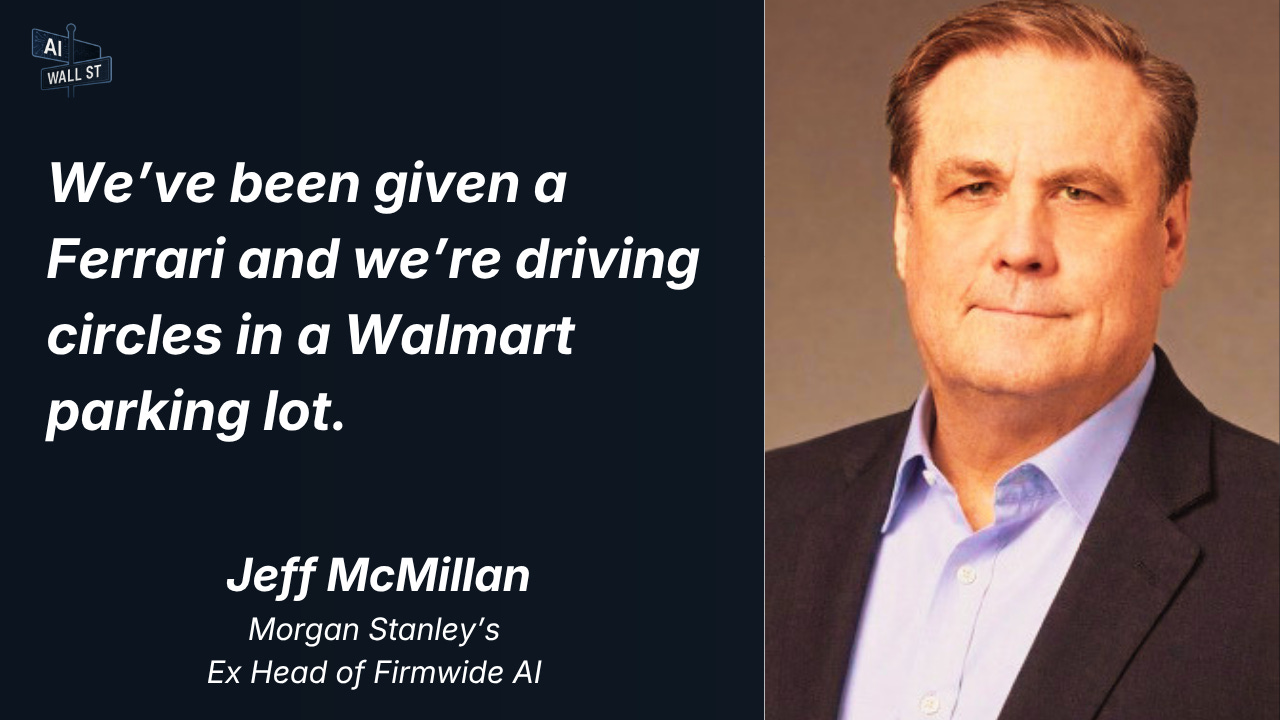
Jeff McMillan helped deploy AI across Morgan Stanley as head of firmwide AI.
His advice: don’t start with technology. Identify work that can be automated.
Many companies are doing the opposite— buying tools first and figuring out where they fit later.
“We’re letting the vendor marketplace drive our strategy as opposed to asking the question: what do you want?”
McMillan, who recently launched McMillanAI, where he advises executives on AI strategy, says many organizations are still early in figuring out how to deploy AI at scale.
In practice, that means starting with tasks that take up a lot of time and are repeated across large teams—call centers, onboarding, compliance review. These are areas where AI can replace or augment work in a measurable way.
What breaks at scale isn’t the model. It’s everything around it: how data is structured, who has access, how systems are monitored, and how much autonomy they’re given.
Most firms haven’t solved that yet. They’re experimenting with tools, but haven’t redesigned how work actually gets done.
We cover:
Identifying high-volume work AI can replace
What breaks when you try to deploy AI at scale
Why most firms are still stuck in pilot mode
How to think about vendors vs building in-house
Where agents are actually being used today (and where they aren’t)
This interview has been edited for clarity and length.
Matt: Why start McMillanAI now?
Jeff: There’s an enormous gap in the marketplace around education and awareness. The people that need to make the decisions — and by the way, I’ve probably spoken to no less than 30 CEOs in the last six weeks, CEOs of Fortune 500 companies — they want to do AI. They’re getting pressured to do AI. But we have a workforce that knows more about this technology than most senior people do in organizations. That’s a gap, and that’s an opportunity.
I don’t want to sound Pollyannaish about this because I’m not: this is a once-in-a-generation type of technology, and I really do believe that we have a choice as humanity. We have a choice about how we deploy this for the benefit of all of us as opposed to maybe a few. I’d like to be part of that dialogue.
Matt: Going back to those 30 conversations, what were the common threads?
Jeff: There’s an enormous amount of external pressure on them. There’s no CEO I talked to that says, “I don’t believe in AI.” That was maybe true three years ago — “Is this just the next crypto? Is it the next metaverse?” No one believes that now. Everyone believes there’s something going on here. So that’s number one.
Number two, there’s a tremendous desire to do something, but they don’t have the skills and the competencies to do this technology at an enterprise level. If you look at every major technical transformation, it takes eight to 10 years to fully play out. So, we’re very early in the process.
The problem with AI is it requires a different approach, and it’s not a technology problem.
