

Hey, it’s Matt. You’re reading AI Street, where I report on how Wall Street uses AI. This week:
News Roundup: Nvidia announces NemoClaw, HSBC, Terminals, Grok
Research: AI for Excel still can’t make it on Wall Street
Interview: Kevin McPartland on the internet-scale impact of AI
Manage Email Preferences
If you’d like to receive fewer emails, you can manage your subscription and turn specific sections on or off.
NEWS
Nvidia Says OpenClaw Is “the New Computer”
Nvidia this week introduced NemoClaw, a software toolkit designed to make OpenClaw usable inside enterprise environments. OpenClaw is an open-source framework for building AI agents that can plan, execute tasks, and coordinate subagents across tools and data sources.
“Every company in the world today needs to have an OpenClaw strategy,” said CEO Jensen Huang. “This is the new computer.”
OpenClaw has quickly become one of the most widely used agent frameworks, allowing developers to build systems that can plan tasks, execute them, and spin up subagents to handle specialized work with limited supervision.
The problem: OpenClaw is a security nightmare as Cisco puts it.
Nvidia hopes its NemoClaw is the answer. The operating system runs agents inside controlled environments, with restrictions on what they can access and how they behave. The system adds monitoring, policy enforcement, and guardrails around data and network activity.
Currently, AI tools are powerful for individuals, but they aren’t designed for coordinated use across teams, systems, and models.
Separately, Meta-acquired Manus launched a desktop application that enables its AI agent to operate locally on personal devices, allowing direct control over files and applications to rival the popular OpenClaw agent.
We’re starting to see a world where AI doesn’t live in a chatbot, but is part of the operating system. That shifts the enterprise question away from “which model is best” and toward something more practical: what specific tasks AI agents can reliably execute inside existing workflows.
You can start to imagine a TaskRabbit-style marketplace for agents, where firms deploy specialized systems on demand to handle discrete tasks.

HSBC is considering cutting up to 20,000 jobs (about 10% of its workforce) over the next three to five years as it uses AI to automate middle and back-office functions, particularly in non-client-facing roles, according to Bloomberg.
I’m skeptical that AI is the primary driver here. (The preliminary plan also includes attrition, restructuring, and potential business exits.)
If AI were already replacing labor at scale, you would expect to see more consistent signals across large banks. That’s not happening yet. JPMorgan, which spends roughly $20 billion a year on technology, reported headcount was essentially flat last month, according to CNBC.
As I’ve said many times around here, there’s currently no clear evidence that AI is dramatically reducing jobs. Maybe that changes, but right now it’s a convenient narrative for broader cost-cutting.
Finance Bros to Tech Bros: Don’t Mess With My Bloomberg Terminal
The rumors of the death of the Terminal are greatly exaggerated. Startups have been “coming for” the financial giant for like 40 years. The WSJ had a piece this week about how the VC crowd misunderstands the staying power of the ubiquitous black and orange screens on Wall Street.
I’m not saying this because I worked there for 10+ years, but because what we’ve seen in this current AI boom: proprietary data is becoming more valuable. Hell, there is so much demand for data, they’re creating synthetic data. The latest models have hoovered up the whole internet and that’s still not enough. Last year, OpenAI was paying YouTubers as much as $4 for a minute of their unused footage.
Incumbents with decades of data have an advantage.
Musk’s xAI Hiring Credit Experts, Bankers to Teach Grok Finance
From Bloomberg:
Elon Musk’s artificial intelligence startup xAI is looking to hire bankers and private credit lenders to make its Grok chatbot better at finance strategy, joining rival AI firms in pushing software for investing professionals.
I still see commentary online that the people training AI are basically talking themselves out of a future job. That’s just not true. From October when news broke that OpenAI was hiring bankers, I wrote:
Reinforcement learning — I’m very much oversimplifying — is basically a giant game of hot and cold. The data helps tell the model when it’s getting “warmer” or “colder” to the right answer. It doesn’t explain why it’s the right answer.
So while AI companies like to market their models as “thinking,” they’re not really reasoning in the syllogistic sense. (All men are mortal; Socrates is a man; therefore Socrates is mortal). These models are mimicking thinking, not doing it.
AI is coming for investment banking tasks. The tech is starting to automate the tedious point-and-click white-collar work that has historically taken junior analysts 100+ hours a week.
ROUNDUP
What Else I’m Reading
Markets misread AI’s impact on brokerages, MS says Investment News
Beyond productivity: AI’s structural shift in active management Schroders
Rogo Acquires AI Agent Company Offset PR
Market data price increases slow for first time in five years: study The Trade
Agentic AI Startup Lyzr Raises Funds at $250 Million Valuation BBG
AI Nears ‘Inflection Point’ in Asset Management MarketsMedia
Six skills for financial service professionals Anthropic
RESEARCH
AI Still Falls Short in Excel: Study
Even the best model wouldn’t make it on Wall Street
AI for Excel has improved dramatically over the last six months, but it still wouldn’t make it as a junior analyst on Wall Street.
The three leading AI providers, OpenAI, Anthropic and Google’s Gemini, have all released updated capabilities for Excel and are reporting higher accuracy on benchmarks.
For example, OpenAI said this month that performance on its internal investment banking benchmark jumped to 87.3% (GPT-5.4 Thinking) from 43.7% (GPT-5).
While these are material improvements, AI still can’t be relied on without supervision. “Mostly right” is not good enough.
A recent benchmark on AI in Excel points to the same issue: performance drops sharply as tasks get more complex.
FinSheet-Bench tests how models handle real-world private equity workbooks with messy layouts, multiple funds, and non-standard formatting. Across 10 models from OpenAI, Google, and Anthropic, the best result came from Gemini 3.1 Pro at 82.4% accuracy, followed closely by GPT-5.2 with reasoning and Claude Opus 4.6 with thinking, both around 80%.
On simple lookups, top models exceed 90% accuracy.
The gap widens further on large, realistic files. On the most complex workbook tested, with 152 companies across eight funds, average accuracy was worse than a coin flip.
INTERVIEW
The Limits of AI in Trading
Kevin McPartland has spent more than 20 years studying how technology changes market structure.
He expects AI to have an internet-scale impact on markets:
𝘐 𝘢𝘮 𝘢 𝘣𝘦𝘭𝘪𝘦𝘷𝘦𝘳 𝘵𝘩𝘢𝘵 𝘵𝘩𝘪𝘴 𝘪𝘴 𝘪𝘯 𝘴𝘰𝘮𝘦 𝘸𝘢𝘺𝘴 𝘭𝘪𝘬𝘦 𝘵𝘩𝘦 𝘧𝘪𝘳𝘴𝘵 𝘥𝘰𝘵-𝘤𝘰𝘮 𝘣𝘰𝘰𝘮. 𝘚𝘶𝘳𝘦, 𝘪𝘵 𝘸𝘪𝘭𝘭 𝘤𝘩𝘢𝘯𝘨𝘦 𝘫𝘰𝘣𝘴 𝘢𝘯𝘥 𝘵𝘩𝘦𝘳𝘦 𝘸𝘪𝘭𝘭 𝘣𝘦 𝘫𝘰𝘣 𝘭𝘰𝘴𝘴𝘦𝘴, 𝘸𝘩𝘪𝘤𝘩 𝘯𝘰𝘣𝘰𝘥𝘺 𝘦𝘷𝘦𝘳 𝘸𝘢𝘯𝘵𝘴. 𝘉𝘶𝘵 𝘪𝘯 𝘵𝘩𝘦 𝘭𝘰𝘯𝘨 𝘳𝘶𝘯, 𝘵𝘩𝘪𝘴 𝘪𝘴 𝘢 𝘵𝘰𝘰𝘭 𝘢𝘯𝘥 𝘢𝘯 𝘢𝘪𝘥 𝘵𝘰 𝘩𝘦𝘭𝘱 𝘱𝘦𝘰𝘱𝘭𝘦 𝘥𝘰 𝘵𝘩𝘦𝘪𝘳 𝘫𝘰𝘣𝘴 𝘣𝘦𝘵𝘵𝘦𝘳 𝘢𝘯𝘥 𝘵𝘰 𝘤𝘳𝘦𝘢𝘵𝘦 𝘯𝘦𝘸 𝘫𝘰𝘣𝘴 𝘸𝘦 𝘥𝘰𝘯’𝘵 𝘬𝘯𝘰𝘸 𝘢𝘣𝘰𝘶𝘵 𝘺𝘦𝘵. 𝘐 𝘳𝘦𝘢𝘭𝘭𝘺 𝘵𝘳𝘶𝘭𝘺 𝘧𝘦𝘦𝘭 𝘭𝘪𝘬𝘦 𝘵𝘩𝘢𝘵’𝘴 𝘸𝘩𝘦𝘳𝘦 𝘵𝘩𝘪𝘴 𝘪𝘴 𝘨𝘰𝘪𝘯𝘨.
He leads market structure and technology research at Crisil Coalition Greenwich, where he tracks how banks, asset managers, and trading firms deploy new systems. He previously worked at BlackRock and TABB Group.
But AI adoption on trading desks has yet to scale.
A recent report from the firm shows the most common use cases among bond traders are still data analysis and document review, not execution or decision-making.
Trading desks face clear regulatory and reputational risk, where firms need to explain and defend decisions to clients and regulators. As McPartland puts it, you can’t tell regulators: “Well, the AI did it.”
In this interview, McPartland explains where AI is being deployed today, what’s holding back trading applications, and why coding and developer productivity may be the most important near-term use case.
This interview has been edited for clarity and length.
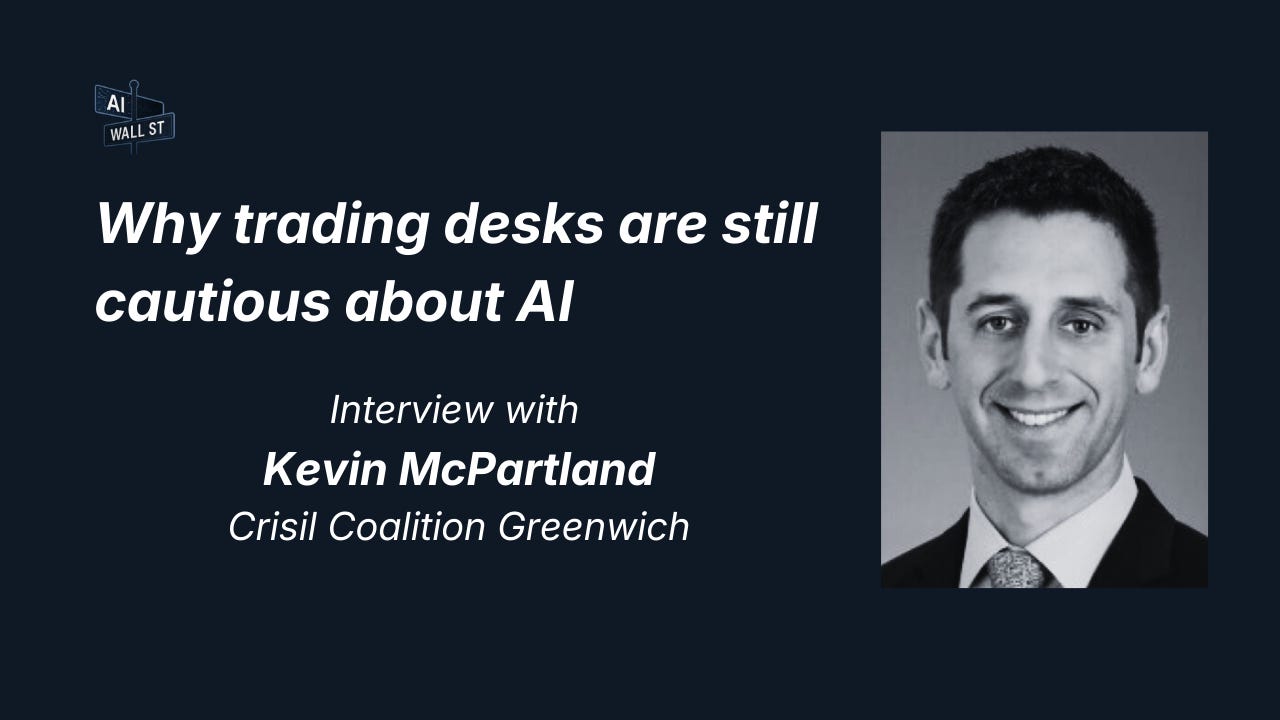
Why AI Adoption in Trading Is Moving Slowly
Matt: I was checking your reports on AI, and you guys are focusing on how it’s in the back office. That seems like it’s the story across the street. When do you think it goes beyond that to more trading applications?
Kevin: I think we’re starting to get there. I was at FIA Boca earlier this week and there was definitely a lot of talk about AI. I think the industry is excited and interested but really trying to be cautious. There’s a reputational risk issue, a regulatory issue. You don’t want to do the wrong thing for your clients from the sell-side perspective. If there’s an issue and regulators come to you and ask what happened, you can’t just say, “Well, the AI did it, I’m not sure.” That’s not a good answer. So I think that’s leaving people cautious.
We actually just got back a study of bond traders and we asked them where they saw the opportunity in AI. Not surprisingly, data analysis was number one, document review number two. So it still really is about poring through data and unstructured data to help digest it, find insights, find patterns. I think that’s still the biggest use case now.
My two cents — I think where really a lot of the impact will be in the short, medium, and long term is on the coding side. Everything from making the most sophisticated quant developers even more efficient than they already are, to letting business users prototype what they want in a way they never could before, and then handing it off to IT. I just think the possibilities are absolutely huge in that regard.
ICYMI


CALENDAR
Upcoming AI + Finance Conferences
AI and Future of Finance Conference – Mar. 19–20 • Atlanta
Georgia Tech event featuring academic and industry leaders like the CEOs of Nasdaq and Snowflake.
QuantVision 2026: Fordham’s Quantitative Conference – Mar. 19–20 • NYC
An academic-meets-industry exploration of AI-driven alpha, multimodal alternative data, and systemic risk. (AI Street is sponsoring QuantVision. Great lineup of speakers!)
Future Alpha – Mar. 31–Apr. 1• NYC
Cross-asset investing summit focused on data-driven strategies, systematic investing, and tech stacks.AI in Finance Summit NY – Apr. 15–16 • NYC
The latest developments and applications of AI in the financial industry.
Momentum AI New York – Apr. 27–28 • NYC
Senior-leader forum on AI implementation across financial services, from operating models to governance and execution.AI in Financial Services – May 14 • Chicago
Practitioner-heavy conference on building, scaling, and governing AI in regulated financial institutions.AI & RegTech for Financial Services & Insurance – May 20–21 • NYC
Covers AI, regulatory technology, and compliance in finance and insurance.
What’s your favorite story this week?
Hit reply with the number of your favorite story. Thanks for reading!
News analysis
AI Still Falls Short in Excel
Interview with Kevin McPartland