

INTERVIEW
Norway’s sovereign wealth fund runs the biggest pool of capital in the world.
And its CEO, Nicolai Tangen, might just be the biggest advocate of AI in investing, calling himself a “total maniac” about it.
Stian Kirkeberg is tasked with implementing Tangen’s vision across roughly $2 trillion in assets and about 8,600 companies as NBIM’s Head of AI and ML.
That scale brings a specific set of constraints: broad market coverage, strict ethical rules, and an organization that has to work reliably across thousands of decisions. An individual can quickly boost their own output with vibe-coded solutions, but that does not necessarily translate into a faster organization. When everyone becomes a coder, productivity can rise in pockets while technical debt quietly accumulates.
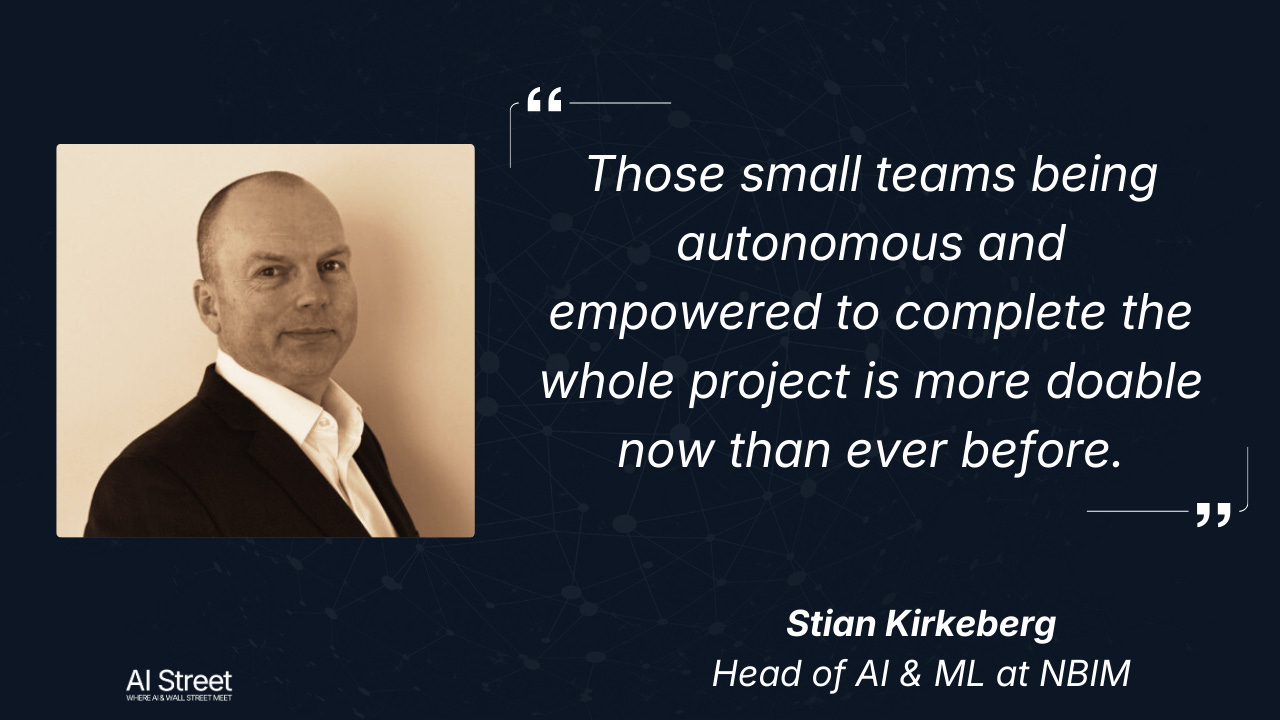
In this interview, Kirkeberg walks through how NBIM is navigating this transition. He explains their partnership with Anthropic, the move from a bottom-up ambassador model to a more centralized strategy, and how small autonomous teams are replacing traditional Scrum structures. He also gets specific about how they reserve GPU capacity from hyperscalers and how LLMs are being used to screen thousands of companies for ESG compliance.
By reading this conversation, you will understand the constraints that show up when AI-driven development scales, and why the biggest hurdle to ROI is not the model’s performance, but the organization’s ability to absorb what it produces.
This interview has been edited for clarity and length.
Matt: How did you get connected with Anthropic?
Stian: Last autumn, Nicolai invited Dario to his podcast. From there, the ball started rolling. While we were evaluating which tool to buy, Anthropic came out on top. At that time, it was OpenAI and Anthropic, and the others weren’t that great.
Matt: It took a decade for the move to the cloud to happen. This technology is still relatively new.
Stian: We were really fortunate to get this collaboration with Anthropic. We started with basic training and prompting for everyone. Then we set up an AI Ambassador Network which grew from 20 to over 70 people. My AI team had meetings with Anthropic twice a week. Ambassadors were tasked with finding a use case in their area, solving it with the AI team, and then showcasing it to the rest of the organization.
We built a lot of momentum with success stories. This was umbrellaed under “Tech Year 2025.” We created mandatory training for everyone in NBIM—seven different modules covering prompting, critical thinking, and responsible AI. We rolled out Claude, Cursor, and Copilot for everyone who wanted it. We had internal conferences in each office where people celebrated good stories and brought in speakers. We even had a Neo1 robot from a company called 1X.
After that bottom-up approach, we needed to identify the most valuable use cases for NBIM as a whole. Consultants interviewed the chiefs and ran workshops, identifying another 171 projects. Phase 3, which we focus on now, is about people delivering value on everything they’ve learned and the tools they’ve been given. We are pushing the cultural change this year to show the value of those investments.
Matt: In practice, where have LLMs proven most useful?
