

Hey, I’m Matt. I’m a former Bloomberg News reporter, and you’re reading AI Street, where I report on how Wall Street uses AI.
AI as Money Manager
JPMorgan researchers built an AI agent to identify economic regimes and used its calls to shift a hypothetical portfolio among stocks, bonds and credit.
The best version produced a 0.95 Sharpe ratio in a 2006-to-2026 backtest, compared with 0.61 for a traditional 60/40 portfolio. All eight configurations produced higher Sharpe ratios than the 60/40 and a rules-based strategy.
Big caveat: it’s very hard to guard against look-ahead bias in these tests because the models may recognize data they’ve already seen, a point the researchers make clear.
The AI analyzed economic and market data each month and assigned probabilities to four regimes: Goldilocks, reflation, stagflation and risk-off. JPMorgan then matched the most likely regime with predetermined portfolio weights. The agent did not select investments itself.
The bank tested OpenAI’s GPT-5.2 and GPT-5.5 and Anthropic’s Sonnet 4.6 and Opus 4.8 at two reasoning levels. GPT-5.2 at the lower level performed best, returning an annualized 6.2% with 6.6% volatility. More reasoning generally did not improve results.
For July, all four models identified reflation as the most likely regime, citing accelerating growth, rising inflation and calm markets.
The report did not say JPMorgan plans to deploy the agent. The researchers said they remain wary of handing asset-allocation decisions to AI. The bank already uses AI to support research, portfolio construction and trading, while leaving investment decisions to humans.
You can already connect Claude or ChatGPT to manage your money. While AI Street readers were not into AI financial avatars in the poll last week, I suspect investors will soon have more institutional options.
SPONSOR
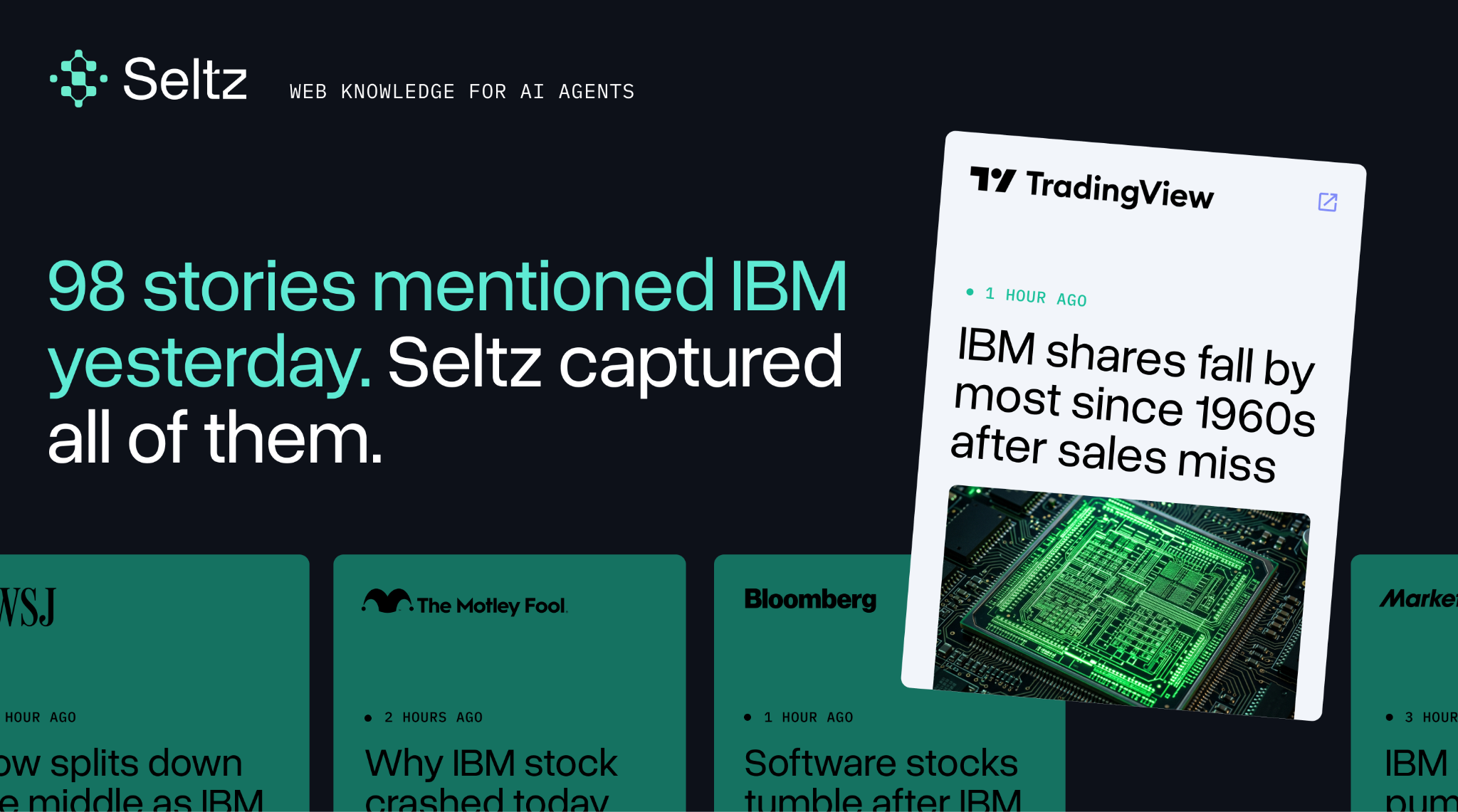
The 25% crash was in every feed; though the feeds couldn’t agree whether it erased $65, $68, or $70 billion, or whether it was IBM’s worst day since 1987, 1968, or ever. The response signal, scattered across outlets no single feed carries.
Seltz returns all of it, raw. Full articles, first-person reporting, within the hour of publication. No summaries, no sentiment scores. Your models do the distillation better than any vendor, on input nothing has influenced.
Search any name across any day in history the same way. That’s how teams build and test a signal before they trade it live. Backed by B Capital and Speedinvest.
Want the full picture on every name you trade? Sign up for a demo — bring 10 questions your desk actually asks, and we’ll run them live.
Booth Professors Put AI Agents to a Live Test
One way (the only way?) to get around look-ahead bias is by running live tests. I’ve covered a number of them here and here.
University of Chicago researchers and trading firm Optiver have launched a new competition to test how well AI agents can explain stock-price moves following earnings announcements.
The agents receive earnings information and make predictions that are scored against subsequent market moves on a public leaderboard. Because the evaluation happens in real time, models cannot benefit from seeing the events in their training data.
The competition builds on research by Ralph Koijen and Bradford Levy, who found that optimized agents increased the share of return variation they could explain from 8% to nearly 20%. (I wrote about this paper for the Chicago Booth Review here.)
Levy said earnings calls offered a practical testing ground.
“Academics and practitioners care about them,” he told me. “In just one quarter, we’ll have a few thousand observations and be able to evaluate how well the models are doing. And every single quarter, we have brand-new, fresh data.”
The next round runs from Aug. 10 through Oct. 2.
Investors managing billions in assets read AI Street.
Paid subscribers access original reporting, data analysis, and interviews with the executives and researchers leading Wall Street’s AI buildout.
Citadel’s AI Does Weeks of Work in Hours
At the beginning of the year, Ken Griffin called AI “garbage,” but has since become convinced of the technology’s wide-ranging impact for the world and investors. In May, he said he went home depressed after seeing AI recreate finance papers in a few hours rather than a few weeks it previously took human experts.
Griffin expanded on those comments in a recent conversation with Goldman Sachs.
My colleague built an agentic AI system that would read a paper, reproduce it, verify the results that were published in the paper, produce the results out of sample, and do all of this work in about, on average, two to three hours per paper.
Now, of note, there’s no reduction to headcount at Citadel on the back of this breakthrough, right? I have incredibly talented people. We have just a huge swath of problems that we’re trying to attack and go after. I will take every single productivity gain I can get because with the talented people we have, we just have more to go after.
This echoes what I’ve been hearing: AI may not reduce demand for human labor, but, in fact, may increase the need for us humans since AI boosts our productivity.

Man Group’s 86x Token Growth
Back in December, I spoke with Man Group’s Ziang Fang about AlphaGPT, the firm’s system for generating quant signals from papers and data. The system proposes a hypothesis, writes the code and runs the backtest before the idea enters Man Numeric’s normal research and investment-committee process.

A new Odd Lots interview with the asset manager’s Chief Technology Officer Gary Collier and Head of Data and AI Tushara Fernando adds more details to the money manager’s current AI use.
The executives said the firm’s token consumption has risen 86-fold since January (27:50). They also described AI use in discretionary investing (8:45), operations and the people team (28:15).
The conversation gets into the operational questions behind that growth: how to structure data for models (20:46), which business unit pays when agents run workflows across the firm (42:06), and how to explain an AI-assisted investment decision (31:23).
AI Spreads Across Wall Street Banks
Wall Street’s biggest banks reported better-than-expected earnings this week and detailed the current state of their AI use cases. The tech is becoming ubiquitous.
Bank of America: 400,000 prompts a day; more than 300 approved use cases.
JPMorgan: Nearly 1,000 use cases, though it sees about 50 as most important.
Citi: More than 80% of employees with access use its AI tools regularly.
Goldman Sachs: AI began in engineering and is now part of a broader push to automate firm processes.
Wells Fargo: Its new AI Teammate helps wealth advisers search, summarize and complete routine workflows.
ROUNDUP
What Else I’m Reading
JPMorgan, BlackRock and Goldman to Tokenize Stocks, Treasurys | WSJ
UK banks join financial services 'Skills Compact' | Finextra
Quant giant Qube preps a new unit of human stockpickers | BI
AI operating system Feathery raises $30 million | Finextra
Hedge Fund Giants Have a New Profit Engine: Their Smaller Rivals | BBG
Kalshi Ramps Up Effort to Build Markets for AI Computing Power | BBG
This Week in AI Street
Why AI Labs Are Buying Market Data

An interview with Databento CEO Christina Qi on unbundling financial data, opaque exchange licenses and raising $97 million as a non-AI company.
QUOTABLE
This quote sounds like it’d be from an executive at an AI company:
It seems inevitable that what is now called "AI investment" will soon be called just "investment."
But it’s from newly appointed Fed Chair Kevin Warsh in congressional testimony this week.
SPONSORSHIPS
Reach Wall Street’s AI Decision-Makers
AI Street reaches institutional investors, C-suite executives and Big Law attorneys at firms including JPMorgan, Citadel, BlackRock, Skadden, McKinsey, and more. Sponsorships are reserved for companies in AI, markets, and finance. Email sponsors@ai-street.co for more details.
CALENDAR
Upcoming AI + Finance Conferences
Artificial Intelligence for Financial Services – July 23–24 • Cambridge, MA
MIT executive-education workshop on AI/ML applications in financial services, emphasizing strategy, use cases, and implementation considerations.
fintech_devcon – August 3–5 • Denver
Developer-focused fintech conference for people building financial products and infrastructure, with technical sessions, demos and networking.FinLLM@IJCAI 2026 – August 15 • Bremen
Symposium on large language models for financial services, bringing together researchers and practitioners.AI for Eco and Finance Summer School & Conference – August 24–28 • Turin
Summer school and conference on applying machine learning to economics and finance.FinovateFall 2026 – September 9–11 • New York
Fintech showcase built around product demos, bank and fintech executives, and financial-services technology.Eagle Alpha Alternative Data Conference – September 10 • New York
Alternative-data gathering for investment and research teams, data providers and vendors.
Thanks for reading!
I’m always happy to receive comments, questions, and feedback.
Connect with me on LinkedIn, or
Send an email to matt [at] ai-street.co