

We’re more than three years into the current AI boom and yet we still lack basic terminology to define the new tools we’re using.
Cornell’s new AI in Finance certificate began in this vacuum. Victoria Averbukh, Professor of Practice and Director of Cornell Financial Engineering Manhattan, spent two years talking to portfolio managers, traders, and strategists before designing it.
“People would say it was about not having a clear way to think about the systems, what the system is doing,” Averbukh said. “New terminology kept coming in.”
Manage Email Preferences
If you prefer to receive one weekly email with all AI Street content, turn off Research and Interviews here:
The program — 30 sessions, 13 instructors — mixes Cornell faculty with practitioners from fintech, asset management, investment banking, and trading. The goal is judgment, not tool proficiency.
Kathryn Zhao, Head of Institutional API Product, OKX, says it reflects a shift already underway in hiring. Domain experience used to be the deciding factor. Now she screens for AI awareness.
“If someone understands how to work effectively with AI tools [...] they can onboard quickly and begin contributing almost immediately,” Zhao said.
In the conversation below, we discuss:
Why applying AI in finance can’t be a direct translation from tech
How the certificate balances academic foundations with practitioner insight
What AI awareness means for hiring and talent development
The biggest stumbling blocks for AI adoption in financial services
Why chasing the pace of change is less useful than building understanding
The below conversation has been edited for clarity and length.
Matt: What was the genesis of this certificate? When did you decide to do this, and what was the catalyst?
Victoria: I kept hearing, across different finance sectors, that people were either using AI and finding it useful but not fully comfortable with whether they could trust it, or they didn’t even know where to start. That hesitation was very consistent—for portfolio managers, traders, execution people, strategists, research people, more quantitative people, less quantitative people. It didn’t really matter. People would say it was about not having a clear way to think about the systems, what the system is doing. New terminology kept coming in. We started with AI, then the word “agent” appeared. It just felt either overwhelming or there was a lack of trust.
My light bulb went on around 2024, about two years ago. I remember that Kathryn and I actually went to have coffee at Breads Bakery on the Upper East Side, and I said, “Kathryn, I have this thought.” And Kathryn said, “Yes!” She was one of my very early supporters. That coffee at Breads Bakery is what gave me confidence to go and investigate more.
Matt: What makes applying AI in finance different from applying it in tech?
Victoria: After speaking with Kathryn, I also spoke with Andrew Chin, Marcos López de Prado, and others. They were all very clear that education is needed, partly because of the hesitation we just talked about, but also because finance is not tech, and applying AI here requires respecting that difference.
Machine learning, big data technologies, and large language models were all built for something else, not for finance. Uber’s business model, for example, is built around offering a service powered by new technology. That is fundamentally different from what a bank or a hedge fund does. So applying AI to investing, to execution, to alpha generation, or even to forecasting market exposure cannot be a direct translation. The objectives are different, and the data is different. Financial data is non-stationary, often smaller, and rarely clean, so you cannot just take machine learning methods from tech and apply them directly.
Our industry is and will continue to adopt AI, but it has to be done carefully, with a real understanding of what works and what does not. Everyone I spoke with strongly supported the idea that training is needed specifically because of these differences, and that developing critical understanding, judgment, and a clear sense of potential ROI before adoption is essential.
Which is why the real question is not whether we use AI, but how we use it in a way that actually improves decision-making rather than just adding complexity.
Matt: Can you talk about the structure of the certificate and the role of practitioners in it?
Victoria: The full certificate is about 30 sessions with 13 instructors. The curriculum is deliberately structured to start from fundamentals — faculty from Johnson School and Engineering explain what the data is, what an LLM is, and work through use cases.
But because it’s so fast-changing, you really need practitioners to understand what needs to be done. Finance is an extremely regulated industry. I think that’s another thing that differentiates it. Even probably from healthcare.
The industry instructors are very carefully curated to give breadth of coverage — fintech, asset management, investment banking, and trading. This is not a certificate just for trading or fraud detection or financial advising. It’s for everybody. Ideally you have some experience on Wall Street, but also if you’re just starting out, it’s really for everybody.
Do you know the quote from Einstein? “If you can’t explain it simply, you don’t understand it well enough.” That was my guiding principle. I know that our Cornell faculty can take the complicated topics — transformers, LLMs, all of that — and make it intuitive. Developing that intuition is really the intention behind the certificate. It’s what enables you to make sound judgments about when, where, and how AI should be used, and when it shouldn’t.
Recent Interviews


Matt: Kathryn, where do you see this heading? How do you see AI impacting finance in the next couple of years?
Kathryn: Speaking from a practitioner’s perspective, my approach to hiring has fundamentally changed. A few years ago, I would evaluate candidates primarily based on their prior experience in the specific role or industry. Today, that is no longer the deciding factor, particularly for junior hires.
What I prioritize now is AI proficiency and AI awareness. If someone understands how to work effectively with AI tools (how to ask the right questions, interpret outputs critically, and apply insights to real business problems) they can onboard quickly and begin contributing almost immediately. With access to AI-generated materials and the ability to leverage AI as a day-to-day copilot, the learning curve is dramatically compressed.
In that sense, traditional domain experience is no longer a strict prerequisite. What matters more is a strong baseline understanding of the real world at a college-educated level, combined with the ability to operate fluently in an AI-enabled environment.
That is why I believe an AI in Finance certificate program is highly relevant. It prepares participants to become AI-aware and AI-capable without requiring them to be programmers. More importantly, the AI literacy and applied mindset the program builds will open a wide range of opportunities for participants in the years ahead.
Victoria: When you say the person needs to be AI-aware—does that mean the person can have zero finance knowledge, or do you mean they don’t need deep knowledge of Python and machine learning?
Kathryn: They don’t need to come in with deep expertise in Python or extensive financial industry knowledge. Those capabilities can be developed on the job. What matters most as a baseline is their ability to work effectively alongside tools like Claude: knowing how to frame the right questions, extract the right information, and translate insights into action.
Victoria: I agree with Kathryn, but maybe a notch below the enthusiasm. Here’s why: This certificate is not about the tools. It’s about understanding the lay of the land and developing intuition. Learning what Claude does can be done on YouTube. There are plenty of tutorials.
The AI awareness Kathryn mentioned, that’s what we bring in the certificate. Ideally, as an educator, I want participants to leave thinking: I know what questions to ask. I know how to bring judgment to that Claude-generated code. So maybe we’re fast-tracking people a little bit through the first nine months on the job once Kathryn hires them.
I also think finance is segmented. You can be an expert in energy, or equities, or fixed income, or mortgages. You can be a really great financial advisor, but you wouldn’t necessarily know how to construct a global allocation as a portfolio manager. At some point, applications of AI are going to become more tailored to all these different areas. It’s almost like you’re not going to go to a dentist if you need new glasses.
Ideally, if this certificate is successful and we offer it again and again, I certainly want to make sure that we have significant participation from practitioners, from industry. Engineers will be inventing new AI 2.0 and 3.0 and 10.5, but the industry participation will always be needed. Maybe we break it up or reshape it to focus on specific areas of finance, that’s also a possibility.
Matt: What is the biggest stumbling block right now for AI adoption in finance?
Victoria: I think it’s uncertainty. I think it’s leadership that is probably older and did not grow up with phones in their hands. There’s a certain inertia. Bridging the generational gap is going to be harder. I think CEOs are going to get younger.
Matt: How do people keep up? It feels like the terminology alone is a moving target.
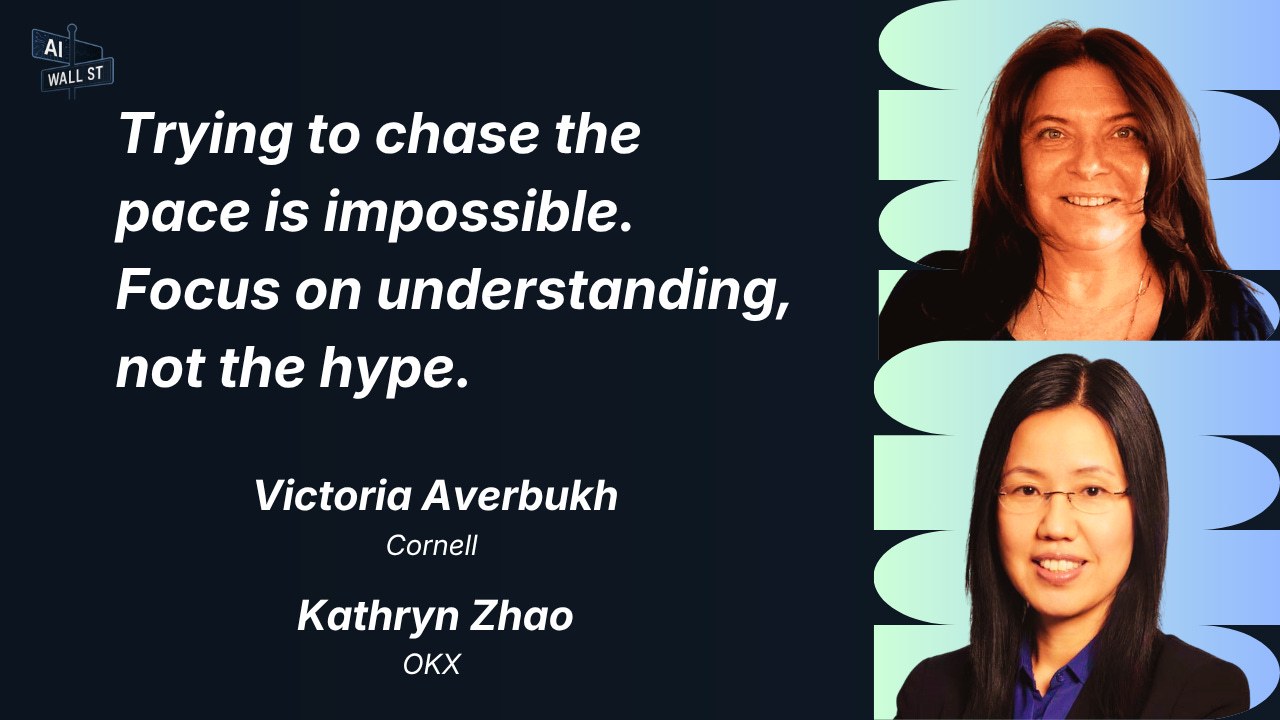
Victoria: There’s no glossary out there. That glossary changes dynamically. That’s going to be part of the certificate. Once people finish, they’re going to know the terms and will be more comfortable and ready for a new iteration of terms. But ultimately, I think trying to chase the pace is impossible. Focus on understanding, not the hype.