

Hey, it’s Matt.
AI Street has moved to Substack! You’re receiving this because you were already subscribed.
Expect the same coverage of AI in markets and interviews with the people building and deploying the tech. Just a new platform. I’ll have more on what spurred the move next week! One request: add this email to your contacts to ensure delivery.
In this week’s edition:
Vista’s Robert Smith says cheaper AI shifts value to enterprise software.
An AI Street interview with Anthropic’s Jonathan Pelosi on using Claude for Financial Services.
News: JPMorgan replaces proxy advisers with “AI.”
ANALYSIS
Vista’s Smith on Where AI Value Accrues
What looks inevitable in hindsight wasn’t a sure thing in the moment.
Lots of examples of this: I like this video from the founders of YouTube worried about the site gaining traction.
That’s why I was interested to see comments from Robert Smith, who’s been investing in technology for 25+ years. His job is to bet on what hindsight is going to be.
He runs $100 billion at Vista Equity Partners, the firm he founded, and recently told CNBC (emphasis mine) :
“AI has sucked a lot of the oxygen out of the air for a lot of investors and pulled them into the Mag 7,” Smith told CNBC. “Those hyperscalers are now starting to build out the infrastructure and capability. Some may argue they’re overvalued in some respects. But the [next] wave will be the application providers. And that’s typically been the way that these cycles have played out. The application providers usually get the lion’s share of the economic rent long term, once the technology has been diffused into those markets and diffused into those technologies. That’s really where we are in the cycle.“
Smith argues that the long-term value of AI is not necessarily with the chipmakers or companies building frontier models, but those firms that leverage low-cost AI into their workflows, a phase that’s just starting. (The price of running an AI model per token continues to drop with no signs of abating.)
Prior to LLMs, software could not execute multi-step workflows autonomously. Agentic systems change that. They allow software to sequence tasks, operate inside permissions, handle exceptions, and log decisions with the level of precision enterprises require.
Vista is betting early on agentic AI, building an “agentic factory” to deploy AI agents across its portfolio, with roughly 30 companies already generating revenue and reporting 30% to 50% productivity gains in coding, according to Smith.
He highlighted Resilinc, one of Vista’s portfolio companies, that helps companies assess their potential tariff exposure and meet regulatory requirements.
This example fits with other use cases we’ve talked about around here, like how Goldman is using AI to draft 95% of IPO prospectuses, help uncover trading ideas at Man Group and debate investment ideas at BlackRock. But in all of these cases a human makes the final judgement call.
As Smith’s comments suggest, the most value will come from companies that can deploy these systems with consistently high accuracy inside real, regulated workflows.
← This also reflects many of conversations I’ve had with folks building in this space: it’s hard. You can spin up an app that looks pretty good but that last 10% is tough.
Takeaway
On Wall Street, agentic systems compress time and cost in research, compliance, and reporting workflows. Humans still make the high-level decisions.
INTERVIEW
Inside Anthropic’s Wall Street Strategy
OpenAI rival Anthropic has focused on selling its models to large enterprise customers. In July, the company launched Claude for Financial Services, a domain specific platform built for regulated finance.
Early users span hedge funds, insurers, and sovereign wealth funds. Bridgewater has used Claude to help researchers query internal documents and data. AIG has applied it to underwriting and risk analysis. Norway’s sovereign wealth fund, NBIM, uses it to work through policy and investment material at scale.
I was happy to speak with Jonathan Pelosi, who leads Anthropic’s financial services effort, about how firms are using the platform. Here is what readers will learn from the conversation.
How Anthropic is tailoring large language models for regulated financial workflows
What Claude for Financial Services is designed to do in day-to-day finance tasks
How skills and Model Context Protocol connect models to firm-specific workflows and data
Why confidence in using LLMs inside financial institutions has increased
Where adoption may expand next, and what is slowing it down
This interview has been edited for length and clarity.
Matt: I am curious how conversations have evolved in the last year. It seems like the technology is moving faster than the industry can scale it. How have the conversations changed?
Jonathan: Confidence has gone up, and for good reason.
People were skeptical because they used it personally and got burned. A year ago, someone might use ChatGPT on their phone for a mortgage calculator and it would be wrong. If that happens, they shelve it and do not take it seriously for work.
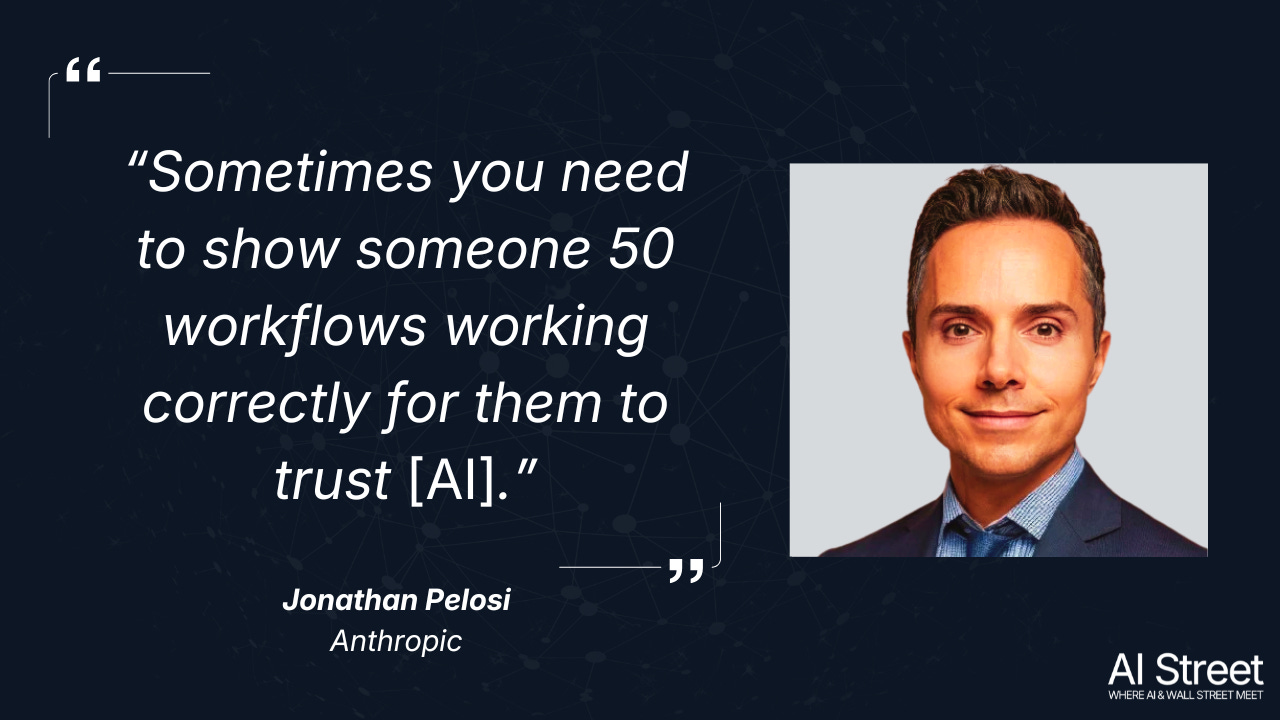
We are as much in change management as in technology. It is reminding and showing people how fast it has improved to rebuild confidence. Sometimes you need to show someone 50 workflows working correctly for them to trust it.
A metaphor is driverless cars. Even if you publish research showing it is as safe as a human, people are reluctant. It is only when it starts hitting something like 10 to 20 times safer that a tipping point happens. In San Francisco, Waymo is everywhere now.
It is similar here. People got burned once, they see a couple wins, still reluctant. Now they are seeing it knock it out of the park repeatedly, and that is where we are. People are giving it their undivided attention.
NEWS
JPMorgan Replaces Proxy Advisers with “AI”
JPMorgan is ditching proxy advisors to use an in-house, AI-powered platform to cast shareholder votes, according to the WSJ.
The bank will rely on its internal AI platform, it’s calling Proxy IQ, to assist with company votes by analyzing data from more than 3,000 annual company meetings and provide recommendations to portfolio managers.
The journal scoop doesn’t have details on how JPM’s system works or how Proxy IQ makes its decisions, but I think this switch reflects a broader trend on Wall Street.
AI lets you automate tedious, rote work that previously needed a human to do. Combing through thousands of company shareholder proposals doesn’t really require higher-level thinking. Just like AI helps with direct indexing, I don’t see why it can’t do the same with proxy votes.
What AI Is and Isn’t Doing to Jobs
Regular readers know that I'm generally skeptical of the AI-is-going-to-take-lots-of-the-jobs narrative. That could happen, but there's limited data that it is happening.
The Fed’s Neel Kashkari said on CNBC that companies have told him that AI is affecting their hiring plans, and he expects to see continued low hiring and low firing in the labor market. The Dallas Fed said this week that while young people’s jobs with high exposure to AI have seen lower employment, “the aggregate impacts are small and subtle.”
On the flip side, jobs considered to be most “at risk,” like programming, may not be:
Herb Sutter, a technical fellow at Citadel Securities and an expert in C++, said the world is chronically short of skilled programmers on his blog last week.
“Programming is a hot market, and programmers are in long-term high-growth demand. AI is not changing this, and will not change it.”
(Btw, Sutter writes in an accessible way, so non-coders like me can understand the programming landscape.)
SPONSORSHIPS
Reach Wall Street’s AI Decision-Makers
Advertise on AI Street to reach a highly engaged audience of decision-makers at firms including JPMorgan, Citadel, BlackRock, Skadden, McKinsey, and more. Sponsorships are reserved for companies in AI, markets, and finance. Email me (Matt@ai-street.co) for more details.
WHAT ELSE I’M READING
Is the AI Boom a Bubble Waiting to Pop? Here’s What History Says BBG
Michael Platt’s Client-Free Trading Decade Racks Up 7,858% Gain BBG
AQR’s Multistrategy Apex Gains 19.6% in Turbulent Quant Year BBG
AI Is Being Used to Find Valuable Commodities in Our Trash WSJ
OpenAI Is Paying Employees More Than Any Major Tech Startup in History WSJ
Ray Dalio says AI is in ‘the early stages of a bubble,’ Fortune/Yahoo
Why agentic AI is the financial markets’ next fundamental hurdle The Trade
Epoch Pitches AI-Powered Quant Platform to Hedge Funds, Banks PR
CALENDAR
Upcoming AI + Finance Conferences
CDAO Financial Services – Feb. 18–19 • NYC
Data strategy and AI implementation in the financial sector.
AI in Finance Summit NY – Apr. 15–16 • NYC
The latest developments and applications of AI in the financial industry.
AI & RegTech for Financial Services & Insurance – May 20–21 • NYC
Covers AI, regulatory technology, and compliance in finance and insurance.