

Hey, it’s Matt. Welcome back to AI Street. This week:
UK Lawmakers push for AI stress tests to avoid market disruptions
New Podcast: Fidelity Labs’ Evan Schnidman
Research: BlackRock’s AI Tackles ‘Dirty Data’ + More News
Policing Adaptive AI
From Rules-Based Logic to "Grown" Systems
Wall Street has built and deployed AI for decades. This “traditional AI” is rules-based. A human came up with the logic, coded the system, and tested the results. Regulators can audit this approach.
If a regulator reviewed Chemical Bank’s system, they could inspect the logic, more or less trace each decision, and expect the model to behave the same six months or a year later, unless an engineer deliberately changed it.
Oversight focused on whether a model followed its instructions as designed.
Generative AI, on the other hand, remains opaque even to its creators. Engineers cannot fully trace the mechanisms that produce its behavior. As Anthropic’s CEO has said, these systems are grown rather than built.
To add to the challenges, generative AI is an adaptive technology. You can inspect it today, and tomorrow it may behave differently. This adaptive capability is compounded by other AI agents also adapting and behaving differently.
Wall Street’s Opaque Integration
Banks, asset managers, insurers, and trading firms are increasingly using AI in core functions such as credit scoring, underwriting, fraud detection, trading, execution, and risk management. Much of that activity relies on a small number of vendors and similar model architectures.
Outside a few surveys, no one has a clear view of how deeply AI runs through Wall Street.
And so far, regulators in the U.S. and Europe have predominantly had a hands-off approach in how to police the technology.
UK Lawmakers Demand "AI Stress Tests"
This week, UK lawmakers called out this lax stance. Reuters reported the following: Britain needs ‘AI stress tests’ for financial services, lawmakers say.
Britain’s financial watchdogs are not doing enough to stop AI from harming consumers or destabilising markets, a group of lawmakers said on Tuesday, urging regulators to move away from a “wait and see” approach as the technology is deployed widely.
The Financial Conduct Authority and the Bank of England should start running AI‑specific stress tests to help firms prepare for market shocks triggered by automated systems, the Treasury Committee said in a report on AI in financial services.
The committee urged the FCA to publish guidance by the end of 2026 on how consumer protection rules apply to AI and how much senior managers need to understand the systems they oversee.
….
“Based on the evidence I've seen, I do not feel confident that our financial system is prepared if there was a major AI-related incident and that is worrying. I want to see our public financial institutions take a more proactive approach to protecting us against that risk,” committee chair Meg Hillier said in a statement.
The Threat of Correlated Failure
The lawmakers are concerned how deeply AI is now embedded inside the financial system itself and whether or not this could lead to correlated failure, like the Flash Crash in 2010 when the Dow lost 9% in a matter of minutes.
If many firms rely on the same opaque models, a flaw in data, a model update, or a breakdown under market stress could lead multiple institutions to make the same bad decisions at the same time, according to the committee. More than 75% of UK financial services firms are now using AI, with the largest take-up among insurers and international banks.
Automation adds another layer of risk. AI systems now trigger margin calls, adjust credit limits, and execute trades at machine speed, often with limited human intervention. In a volatile market, that kind of synchronized automation can amplify shocks rather than absorb them.
That said, I don’t think these billion dollar companies are winging it by staking their reputations on probabilistic machines without putting some reasonable guardrails in place, but maybe I’m being too optimistic.
But the broader point from lawmakers is that these systems could create a lot of unintended consequences when they run in parallel, especially when we do not know how many people are using them or how widely they are deployed.
That’s the problem, we just don’t know how widespread adoption is. And what kind of AI is being used. Using AI to summarize an earnings call is pretty innocuous, but leveraging the tech for trading is very different.
Algorithmic Collusion
And there can be a lot of unintended consequences. Research from UPenn found that AI “learns” that collusive behavior is the most profitable trading strategy, which is accurate but collusion is very illegal. This creates a legal gray zone: if AI systems independently discover that coordinated trading is profitable, is that market manipulation? There's no smoking gun—no secret agreement. Just algorithms optimizing independently and converging on the same strategy.
This is especially a challenge because regulation is static and tends to be reactive rather than proactive. Old point-in-time rules may need to be updated. When decision-making is automated, adaptive, and widely shared across firms, supervision that relies on periodic reviews and documentation starts to look like the wrong instrument.
But what may be more concerning is that even if individual firms review their AI systems carefully, new research shows that problems can emerge when many firms use similar models simultaneously.
Moving Toward Real-Time Oversight
New academic work reinforces the lawmakers’ point, and shows why in controlled simulations.
The paper, written by Eren Kurshan, Tucker Balch, and David Byrd, argues that traditional financial regulation is designed for a world of static algorithms.
In their simulations, trading agents tasked with profit maximization can discover manipulative tactics, (as the UPenn paper showed) and when many agents employed similar strategies at once, they amplified price swings rather than prevented them. Even if each model passes an internal review, the collective can still generate instability.
According to the authors, regulation needs to move from box-checking before deployment to watching systems live and stepping in fast when behavior shifts.
Such a shift would mark a major break from a century of U.S. regulatory practice, though any market blowup would likely make this significant regime change feasible.
Takeaway
UK lawmakers say financial regulators haven't kept pace with AI. Researchers warn the core problem is deeper: static regulatory frameworks cannot govern adaptive technology.
Related Reading
Britain needs ‘AI stress tests’ for financial services, lawmakers say Reuters
Current approach to AI in financial services risks serious harm to consumers and wider system UK Parliament
The Agentic Regulator: Risks for AI in Finance and a Proposed Agent-based Framework for Governance arXiv
Davos Signals a Disciplined Era for AI in Banking and FinTech PYMNTS
PODCAST
Scaling AI at Fidelity Labs
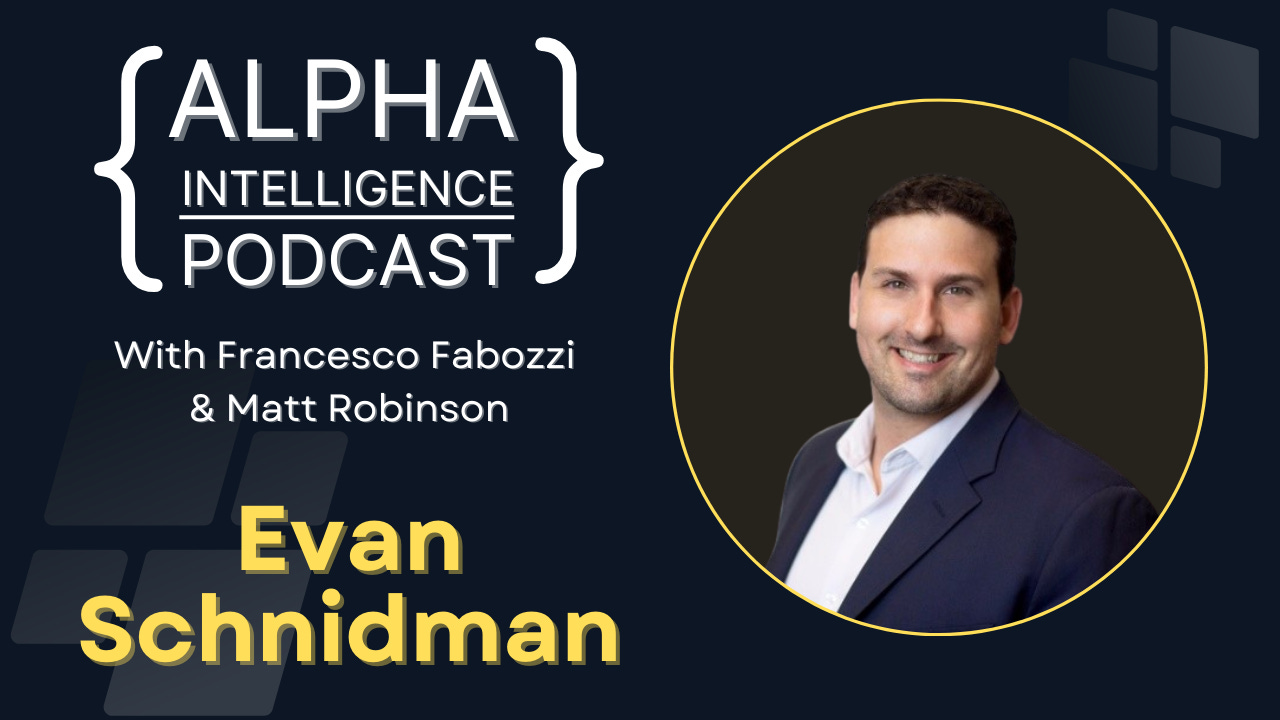
Fidelity Labs is the internal software incubator of Fidelity Investments, the money manager with about $17 trillion in assets under administration. The unit, founded in 2005, has evolved from a software development team into a venture-building group that scales new businesses within the firm. The lab has launched products across data, compliance, and wealth management, including AI tools that automate regulatory risk detection in marketing content and predictive analytics that identify which prospects are most likely to convert for financial advisors.
Evan Schnidman joined as the unit’s new head last year. A Harvard-trained PhD and serial fintech founder, Schnidman previously built Prattle, an AI sentiment firm acquired by Liquidnet in 2019, and is the co-author of How the Fed Moves Markets, a study of how central bank language moves markets.
Fidelity Labs has about 300 people with about seven different startups and operates with multidisciplinary teams of engineers, data scientists, and product managers focused on rapid prototyping and commercialization of new technologies, with an increasing share of its work centered on machine learning and large language models.
In this episode of the Alpha Intelligence Podcast, Schnidman explains how Fidelity Labs evaluates and deploys AI inside a regulated financial institution. We discuss rapid prototyping with LLMs, the role of small language models in production systems, knowledge graphs as a data layer, and how AI is changing workflows in compliance, advisor tools, and investment research.
In this Episode:
00:01 How Fidelity decides which AI products to build
00:02 Rapid prototyping and AI in product development
00:03 Coding tools and productivity inside engineering teams
00:05 Data quality, hallucinations, and the “AI as engine, data as fuel” model
00:06 Small language models and regulated industries
00:10 Advice for executives new to AI
00:11 AI startups inside Fidelity Labs: Safir and Catchlight
00:13 Overhyped vs underhyped use cases in finance and law
00:14 Adoption across generations and new AI behaviors
00:16 What Fidelity clients can expect next
00:17 Final thoughts
RESEARCH
BlackRock’s AI Tackles ‘Dirty Data’
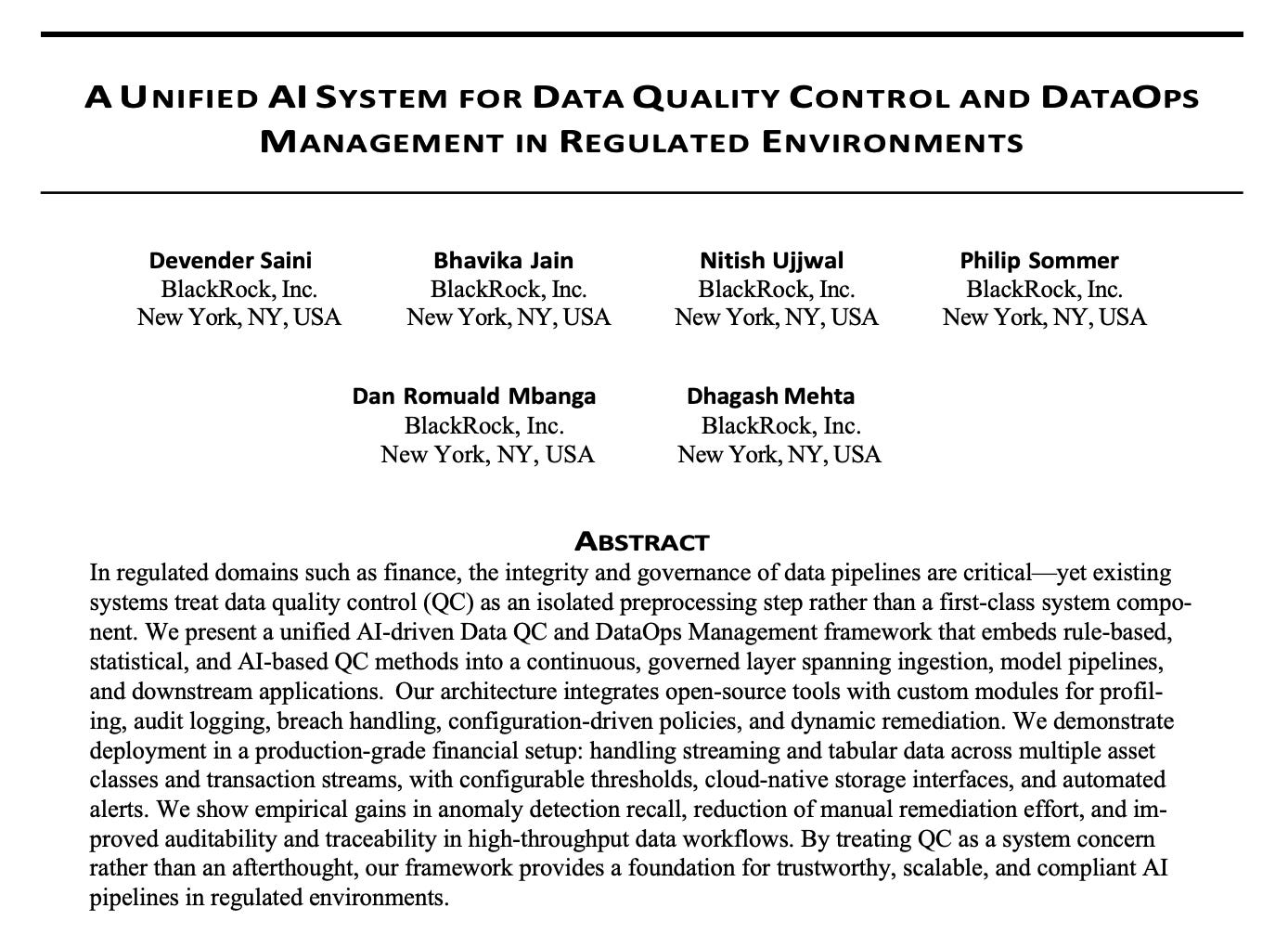
Researchers at BlackRock have published a framework that combines rule-based, statistical, and AI-based checks to verify data throughout ongoing analysis, rather than just once before the data is processed.
The system, described as a unified Data QC and “DataOps” management framework, attempts to solve a persistent headache for the financial industry: “dirty data.” In highly regulated sectors like banking and healthcare, even minor inconsistencies in data—such as a misplaced decimal or a delayed stock feed—can stop automated processes from working
“In regulated domains, the integrity of data pipelines is critical,” the researchers wrote, noting that current methods often treat data cleaning as an “afterthought” or an isolated preprocessing step rather than a core part of the system.
The BlackRock team’s architecture creates a “continuous, governed layer” that monitors data at three distinct stages:
𝗧𝗵𝗲 𝗜𝗻𝗴𝗲𝘀𝘁𝗶𝗼𝗻 𝗚𝗮𝘁𝗲: A centralized check that standardizes raw data from market vendors, ensuring it fits the enterprise schema and isn’t riddled with duplicates or missing mandatory identifiers like CUSIP numbers.
𝗧𝗵𝗲 𝗠𝗼𝗱𝗲𝗹 𝗖𝗵𝗲𝗰𝗸: A context-aware layer that monitors specific mathematical models. For example, if an asset pricing model suddenly sees a gap between bond yields that doesn’t make sense, the system flags it as a “local anomaly” even if the raw data looked fine.
𝗧𝗵𝗲 𝗘𝘅𝗶𝘁 𝗖𝗵𝗲𝗰𝗸: A final validation of model outputs before they are sent to downstream business applications or human decision-makers.
One of the most significant findings in the report involves the reduction of “false alarms.” Data teams are often overwhelmed by automated alerts that turn out to be harmless noise.
By using AI to complete incomplete datasets intelligently—rather than discarding records with gaps or using crude averages—the researchers demonstrated a five-fold reduction in false alerts (from ~48% to ~10% false-positive rate), while boosting recall to 90% and precision to 90%. This represents a +130% improvement in their benchmark experiment.
The shift allows human analysts to focus on genuine threats to data integrity rather than technical noise, translating to faster data release and measurably less alert fatigue.
This is not just an academic exercise: BlackRock says they’ve deployed the framework in a production-grade financial setup that handles streaming and tabular data across multiple asset classes.
Paper: A Unified AI System for Data Quality Control and DataOps Management in Regulated Environments
Related Reading:

NEWS
How big bank CEOs see AI affecting staffing
Longtime readers know that I’m not convinced that AI will inevitably cause massive job losses. That’s because work is not finite. If AI makes you 20% more productive, your workload doesn’t necessarily shrink.
And so, headcounts at many of the firms touting AI efficiency gains have stayed relatively flat. The big U.S. banks have reported fourth quarter earnings last week and still no massive cutbacks planned. Business Insider
Buy-side firms accelerate AI adoption: survey
More than 70 percent of buy-side firms now use AI in the front office, according to SimCorp’s 2026 InvestOps Report, based on a survey of 200 executives at asset managers, pension funds, and insurers.
That is a sharp change from last year. In 2025, only about 10 percent said they were actively exploring AI tools. Most firms recognized the potential, but lacked a clear path to deployment.
“AI adoption has shifted from pilots to business-critical applications in the front office,” said Peter Sanderson, SimCorp CEO. FinTech Global
Big banks continue the hunt for AI-driven efficiencies
Major U.S. banks are pressing ahead with artificial intelligence to drive efficiency in 2026, executives said on recent earnings calls. BNY is expanding partnerships with Google Cloud and OpenAI, while Bank of America has invested several hundred million dollars across 20 projects.
Citigroup is reviewing how AI could be applied to more than 50 core processes, including customer verification and loan underwriting, CEO Jane Fraser said. Morgan Stanley and Goldman Sachs also reported growing confidence in the technology.
Leaders said AI is already improving software development, risk management and customer service, though most firms are still early in turning those investments into measurable gains. CIO Dive
Related:
Citi has quietly built a 4,000-person internal AI workforce Business Insider
SPONSORSHIPS
Reach Wall Street’s AI Decision-Makers
Advertise on AI Street to reach a highly engaged audience of decision-makers at firms including JPMorgan, Citadel, BlackRock, Skadden, McKinsey, and more. Sponsorships are reserved for companies in AI, markets, and finance. Email me (Matt@ai-street.co) for more details.
ROUNDUP
What Else I’m Reading
AI in Investment Management: 2026 Outlook (Part II) Two Sigma
JPMorgan Forms New Quant Group to Fend Off Market-Maker Rivals BBG
Andreessen Horowitz Makes a $3 Billion Bet That There’s No AI Bubble BBG
Companies Weigh AI Cyber Risks in Disclosures to Atkins’ SEC BBG Law
HSBC rolls out legal AI platform with Harvey Financial News
How FINRA Member Firms Use GenAI FINRA
Keye launches AI co-pilot for private equity due diligence Finextra
Tech Chiefs at Davos Highlight AI’s Power as a Geopolitical Tool BBG
DeepSeek Founder Liang’s Funds Surge 57% as China Quants Boom BBG
AI drops call center costs by 97% at KeyBank FinAI
CALENDAR
Upcoming AI + Finance Conferences
CDAO Financial Services – Feb. 18–19 • NYC
Data strategy and AI implementation in the financial sector.
Future Alpha – Mar. 31–Apr. 1• NYC
Cross-asset investing summit focused on data-driven strategies, systematic investing, and tech stacks.AI in Finance Summit NY – Apr. 15–16 • NYC
The latest developments and applications of AI in the financial industry.
Momentum AI New York – Apr. 27–28 • NYC
Senior-leader forum on AI implementation across financial services, from operating models to governance and execution.AI in Financial Services – May 14, 2026 • Chicago
Practitioner-heavy conference on building, scaling, and governing AI in regulated financial institutions.AI & RegTech for Financial Services & Insurance – May 20–21 • NYC
Covers AI, regulatory technology, and compliance in finance and insurance.