

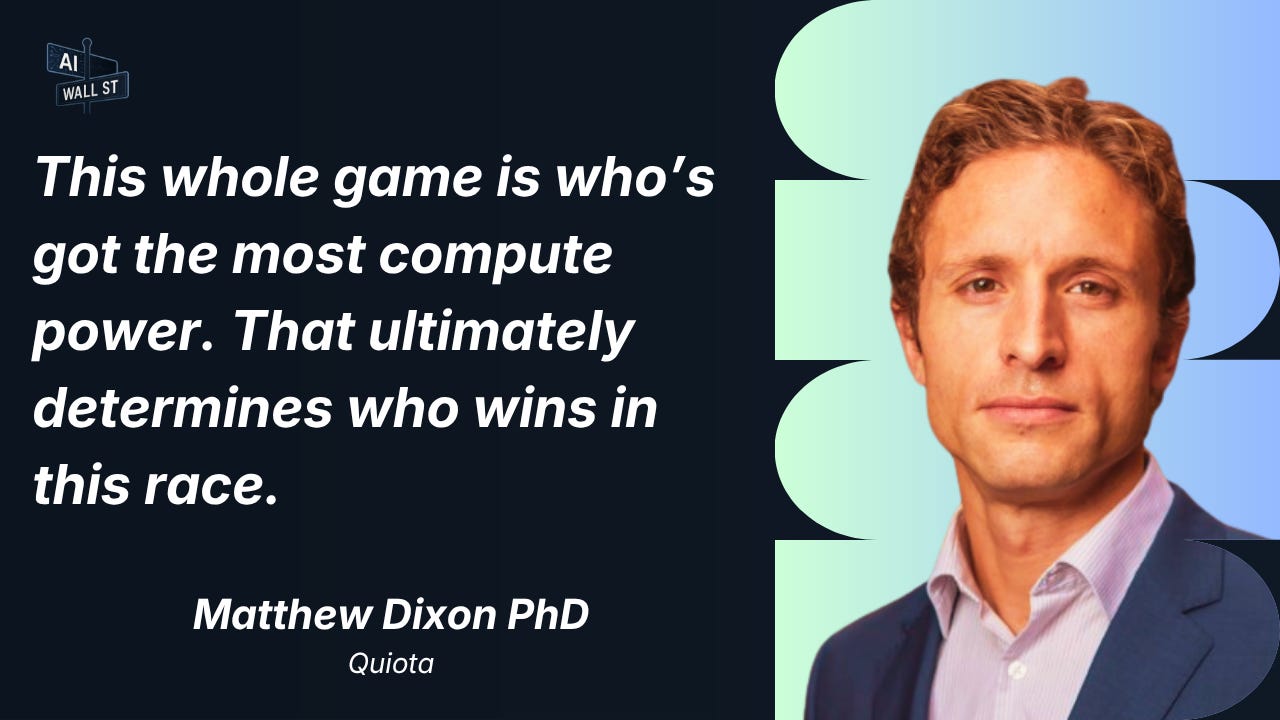
Whoever has the most compute wins. That’s Matthew Dixon’s blunt summary of where quantitative finance is heading.
Dixon, who co-wrote the textbook Machine Learning in Finance, worked in structured credit, and holds a PhD in applied math from Imperial College London, argues that talent, models, and mathematical elegance are increasingly constrained by the hardware budget behind them.
Dixon’s point is that brute force gets you a long way in finance. Most applications are not precision engineering problems — they are approximations where more compute buys a better answer. Firms that have the resources to scale compute are pulling ahead of peers that cannot.
Compute catches up
One of the most basic questions a large bank has to answer is also one of the hardest: What is the profit and loss on my positions today?
For years, financial firms didn’t have the computing power to analyze their positions quickly. For a large bank, getting one simulation number out of tens of thousands of positions requires teraflops of processing. Stress testing and marginal analysis stack on top of that. “The bulk of the load sits in any trading strategy that involves derivatives: hedging positions, marking to market, getting an overall risk profile,” says Dixon, who now runs his own consultancy, Quiota. GPUs helped — they were already good at parallelizing simulation threads before deep learning arrived. When deep learning did arrive, it fit the GPU architecture almost perfectly.
Stale overnight
Risk models have traditionally run overnight. A market shock hits and every parameter is useless. "You wake up and there's a big news event, say, the Suez Canal is blocked, there's war with Iran, and the data regime is completely different, and all your parameters are stale." AI surrogates, deep learning models trained on the output of those expensive simulations, can now recalibrate in seconds. Instead of rerunning the whole model, you feed in the latest data and out pops a value. Dixon says tier-one banks have been pursuing this with varying degrees of success.
Compute as cost
More compute solves the speed problem but creates a spending problem. “One bank told me the cost of running jobs on rented cloud compute had become a major expense.” Significant enough to drive infrastructure decisions. And security adds a constraint — these firms don’t want sensitive positions sitting on someone else’s servers. Operational cost is now the barrier to entry, the same way an expensive platform was always the price of admission in high-frequency trading.
Research compressed
The research cycle is collapsing. “If you want a model for a new financial instrument, describe it with a few equations, and AI will generate the mathematics to figure it out. What would have taken weeks takes minutes now.” That changes the economics of building new products entirely. Engineers Dixon works with tell him they haven’t actually coded since last September — Copilot or Claude does everything. The frustration is in the last mile. “You’re on the putting green and it pulls out a driver,” he says. You get to the prototype fast, but one incremental change request and the codebase shifts so much that no one is sure what it does anymore.
Dixon was named one of Risk magazine’s 2022 buy-side quants of the year, with Igor Halperin, for machine-learning research in wealth management. This interview has been edited for clarity and length.
Matt / AI Street: What do banks and trading firms spend most of their computing power on?
Matthew Dixon: I’d break it down broadly, across buy-side and sell-side. You’ve got portfolio optimization, asset management, which is always resource-intensive. But I think the bulk of the load sits in any trading strategy that involves derivatives: hedging positions, marking to market, getting an overall risk profile. That’s where you get into expected shortfall and value at risk. Banks have to do that as a legal requirement. Those computations are where the heavy lifting is.
That was all before AI, and all of it is simulation. GPUs came along and were very good at parallelizing independent simulation threads. The problem was they had limited onboard memory, and it took a lot of latency to move data into that memory. The old saying was: you don’t get out of bed for GPUs unless you’ve got heavy compute and not too much data movement. What worked really well were risk simulation, pricing, optimization, signal detection: all compute-intensive work.
Then deep learning arrived and fit the GPU architecture almost perfectly. The hard work of mapping routines onto GPUs was already done: NVIDIA’s custom libraries, Intel’s equivalents. And suddenly you had a new possibility for derivatives pricing and risk. Instead of running complex models overnight and missing a recalibration window when the market moves, you could train an AI to learn the metasurface of a risk model. Then it becomes a lookup function. Feed in the latest data, out pops a value.
I know tier-one banks have been looking at doing this for some time, with varying degrees of success. I was approached by one, I’m not at liberty to say who, and they were explicit about what they needed. It’s really around derivative products where all the headache is.
Behind the paywall: Dixon on stale risk models, teraflop-scale bank workloads, compute costs, regulatory limits on bank AI, and the compression of quant research.
Paid subscribers also get the full AI Street interview archive and deeper analysis of how banks, trading firms, and asset managers are deploying AI.
