

Hey, I’m Matt. I’m a former Bloomberg News reporter, and you’re reading AI Street, where I report on how Wall Street uses AI. On Tuesdays, I highlight novel research, emerging use cases, and expert interviews.
The insurance startup Corgi, valued at $5 billion and backed by Y Combinator, has launched more than 200 ETFs this year in part with the help of AI.
That total is already the fourth most offered by any U.S. ETF provider and exceeds the roughly 190 U.S. ETFs offered by State Street, which launched its first ETF in 1993—before Corgi’s founders, Nico Laqua and Emily Yuan, were born. The company, which is named after the dog breed, said in August it expected to have more ETFs than industry leader BlackRock (~460) by the end of the year.
Using AI in all parts of its business is central to the company’s strategy. Laqua, Corgi’s CEO, has said that insurance involves interpreting contracts, generating regulatory reports and reviewing claims—all language-based work. “In our case, we automate as much of that as possible,” he said.
“Our focus is on driving down costs,” Laqua said in an interview with CNBC’s ETF Edge, “having the lowest fees typically in whatever category we’re in.”
THE BIG PICTURE
A two-year-old insurance startup uses AI to undercut rival ETF fees and has amassed about $580 million in assets in less than a year, aiming to become the “Walmart” of ETFs.
Laqua says automation helps Corgi offer ETFs at lower prices than its competitors. For example, one fund that seeks to match twice the daily returns of Tesla charges 20 basis points, or 0.20%, a year. Similar products can charge more than 80 basis points, or 0.80%, annually.
In an analysis run by AI Street, AI detector Pangram flagged about half the text in one of Corgi’s SEC filings as potentially AI-generated. A spokesperson for Corgi didn’t respond to requests for comment.
PRESENTED BY BRICKROAD
Meet Scouts: Your AI Team for Data Search
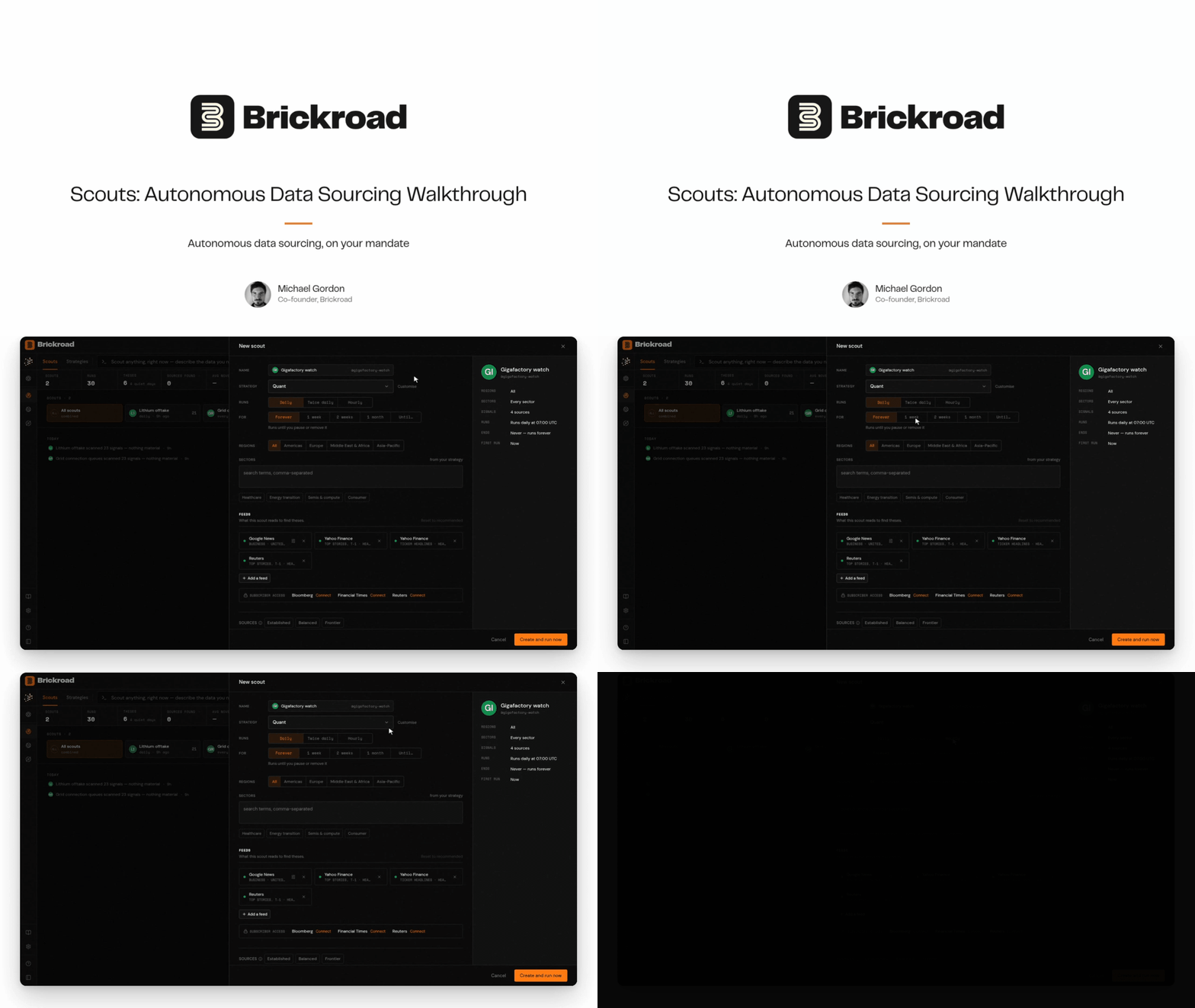
Brickroad has launched Scouts, an always-on AI data sourcing team that finds datasets, spots new suppliers and gets you samples to evaluate.
Give a scout a strategy, a mandate and a schedule. On each run, it reads Brickroad’s internal market signals and news feeds you can configure, then launches agents to find data that fits your requirements.
Review the datasets and suppliers it finds, then select the samples you want. Brickroad’s agents contact the suppliers, arrange access and fetch samples you can review, download or analyze.

Using AI to Create the Walmart of ETFs
One of the recurring themes we talk about around here is how AI reduces friction. You can test more ideas, and pursue more research avenues because the cost in time and expense is so low. This is the approach Corgi is taking with ETFs. If you can launch and operate a fund at much lower cost, you can potentially break even with fewer assets. The FT reported in July Corgi had about 10 people running the fund business.
“You can’t run Walmart with a lot of overhead,” said Jeff Weniger, former head of equity strategy at WisdomTree and now chief investment strategist at Corgi Invest, in an interview on Bloomberg’s Trillions podcast.
While Corgi lists more than 200 ETFs, most of the assets sit in a handful of funds. The biggest is its Chipmaking laser tech fund, which has $230 million in assets, and the smallest fund is its 2x EOS fund, tied to a battery stock, with $22,000 in assets.
QUOTABLE
“AI really can plug into every single part of the operational business. I mean, filing ETFs and launching product is really a words-based industry and … large language models are very good at using words.”
Nico Laqua, Corgi’s CEO, said in a CNBC interview.
Datamule Analysis
I took a look at Corgi because of analysis by John Friedman at Datamule, who I’ve written about before. He ran SEC filings from the 1990s to November of this year through his own custom AI-detection model. (It’d be far too costly to run all of those SEC filings through a commercial detector.) He found that a small but growing share of filing text is AI-generated. His model prizes breadth over accuracy. He said processing the full corpus cost about $15, but his model both misses AI-generated text and incorrectly flags human-written text.
Other findings:
Ethics code documents have the most AI-generated text of any document type.
Software companies do have more AI-generated text.
Crowdfunding has a lot of AI-generated text.
F-1 filings (foreign IPOs) have more AI-generated text than S-1 filings (domestic IPOs).
Annual Reports to Shareholders contain much more AI-generated text than Annual Reports (10-Ks).
The Corgi filing that I ran through Pangram had among the highest shares of AI-flagged text in Datamule’s analysis. You can find more details on Friedman’s methodology and results here.
Pangram Analysis
Behind the paywall
Access to Pangram’s analysis of Corgi’s 300,000-word filing.
Examples of text classified as AI-generated and human-written.
A breakdown of which sections appeared more AI-generated than others.