

Hey, it’s Matt. This week in AI on Wall Street:
Interview: Numerai’s Richard Craib on retooling the hedge fund for AI Agents
Research: AI stock picks beat benchmark in live market test
News: JPMorgan retools banking units around AI
INTERVIEW
The Crowdsourced Hedge Fund Is Going Agentic
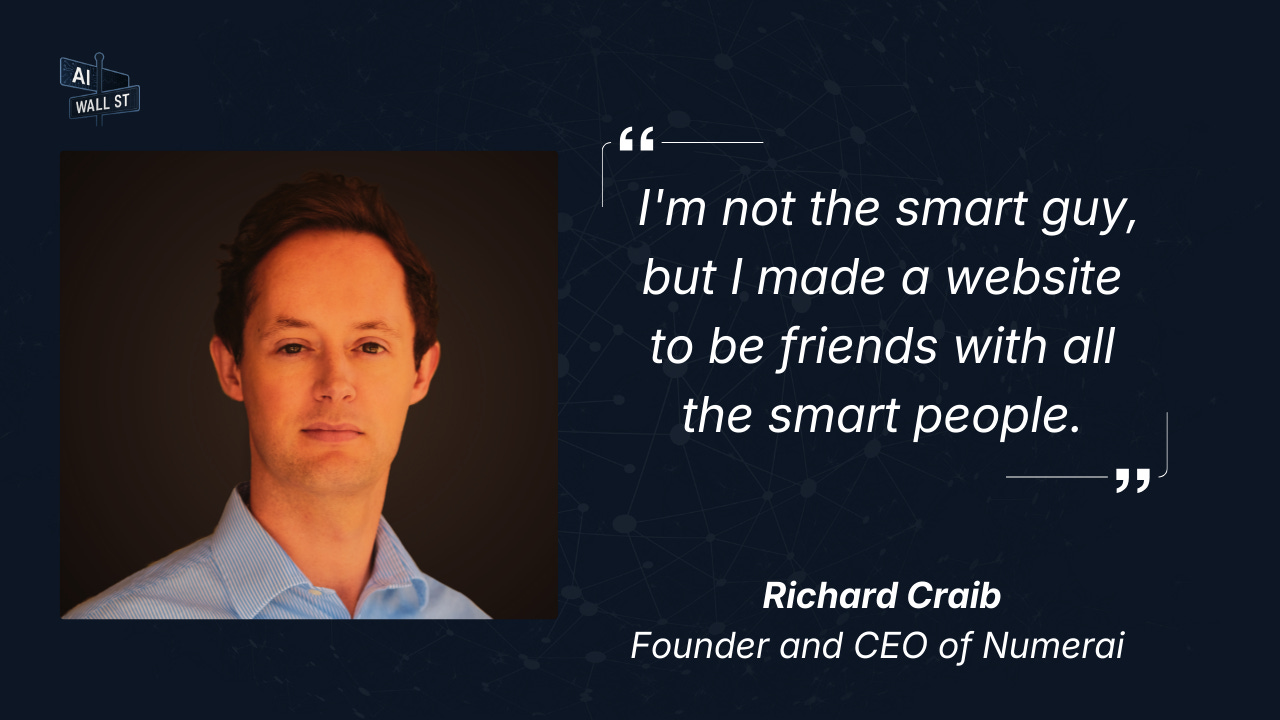
Richard Craib runs one of Wall Street’s most unconventional business models: a crowdsourced hedge fund. He also counts JPMorgan as his biggest backer.
Craib, a South African mathematician, launched Numerai in 2015 in San Francisco, far from the epicenter of finance in New York, with the goal of reinventing how hedge funds are built.
Numerai crowdsources stock market predictions from thousands of data scientists worldwide by providing encrypted financial data that obscures the underlying securities. It then aggregates those forecasts into a single trading strategy. Contributors stake the company’s cryptocurrency, Numeraire, on their models, earning rewards for strong performance and losing funds for poor results.
Despite its unconventional structure, Numerai manages real capital and in August secured a commitment of up to $500 million from JPMorgan Asset Management, potentially more than doubling the fund’s size. The investment followed a strong year for the fund, which reported a 25.45% net return in 2024 with a Sharpe ratio of about 2.75.
For much of its history, Numerai framed itself as a hedge fund built by machines but guided by humans.
Craib is now reworking Numerai for autonomous research. Last month, the firm outlined plans to redesign its system to support agents rather than just human data scientists, including a new Model Context Protocol interface that would give AI systems direct programmatic access. Under that framework, agents could create models, submit predictions, run validation tests and monitor performance on their own, effectively executing the full research cycle without manual intervention.
The shift reflects Craib’s view that advances in modern AI tools have changed who, or what, can participate. Human users are expected to move toward designing and supervising AI research assistants rather than building models themselves, while updated staking mechanisms would allow agents to manage financial exposure programmatically.
He expects agents to spread quickly across quantitative finance, potentially reshaping how ideas are generated, tested and traded.
In our chat, we discuss:
Why Numerai is redesigning its platform for autonomous AI agents, not just human quants
How large language models became capable of running the full research cycle with the right scaffolding
Why Craib believes future hedge funds will rely on “AI scientists” exploring vast idea spaces
How the JPMorgan investment came together and what it signals for institutional adoption
Why Craib thinks many traditional fund roles, and even star managers, could become obsolete
Here are some of my favorite quotes:
“I’m not the smart guy, but I made a website to be friends with all the smart people.”
“You’re just gonna see very quickly people feeling they’re doing
it wrong if they’re not using agents.”
“The way I see it is more like these models are themselves AI scientists,
and they weren’t a year ago.”
This interview has been edited for length and clarity.
Matt: You started Numerai about 10 years ago, when AI was not as prominent. Now you have JPMorgan investing. How were those first couple of years?
Richard: Actually, I thought when I was starting it, AI was a bubble in 2015. It felt that way. Google had acquired DeepMind for $500 million, which people thought was just really extreme. There was a lot of different kinds of hype at that time, and I guess we were more in the machine learning space, and we weren’t quite on LLMs yet. But that was AlphaGo in 2016, right when Numerai started. But it ended up not being a bubble at all. There was a lot more to come.
Matt: It’s still an unusual model for a hedge fund. Looking at your recent Numericon announcements, it seems you are setting up the infrastructure for submissions that don’t necessarily come from humans.
Richard: We’ve actually always thought about it that way. When you signed up in 2016 on Numerai, it didn’t say “enter your username,” it said “name your AI.” You were not the one who was doing anything, except setting up the learning algorithm to start learning, and then AI would be the thing submitting. And now that’s become even more true, because even the code that you would write to generate the model, even that code can be written by AI. So, we just see it as another abstraction.
Put it this way, we were never asking data scientists to write machine learning algorithms in assembly code. They were using the most extreme abstractions, so they would use scikit-learn in Python, or TensorFlow, and now there’s another layer of abstraction, which is Claude can do TensorFlow for you, or PyTorch for you.
It’s natural for us since the beginning of ChatGPT since it’s always known about Numerai. It knew how to make a basic model, even on the first version, but then it got better and better. So, users have always been using the chat interface, but we never fully enabled native agent support until Numericon.
RESEARCH
AI Stock Picks Beat Benchmark in Live Market Experiment
Many AI + investing research papers suffer from the same problem: the models were trained on historical internet data that often contains the outcomes they are asked to predict. Ask a model today what happened to a stock in 2022, and it may already know.
This look-ahead bias makes me skeptical of many papers with “big” conclusions. But since the models have become ubiquitous, researchers can test their theories in real time.
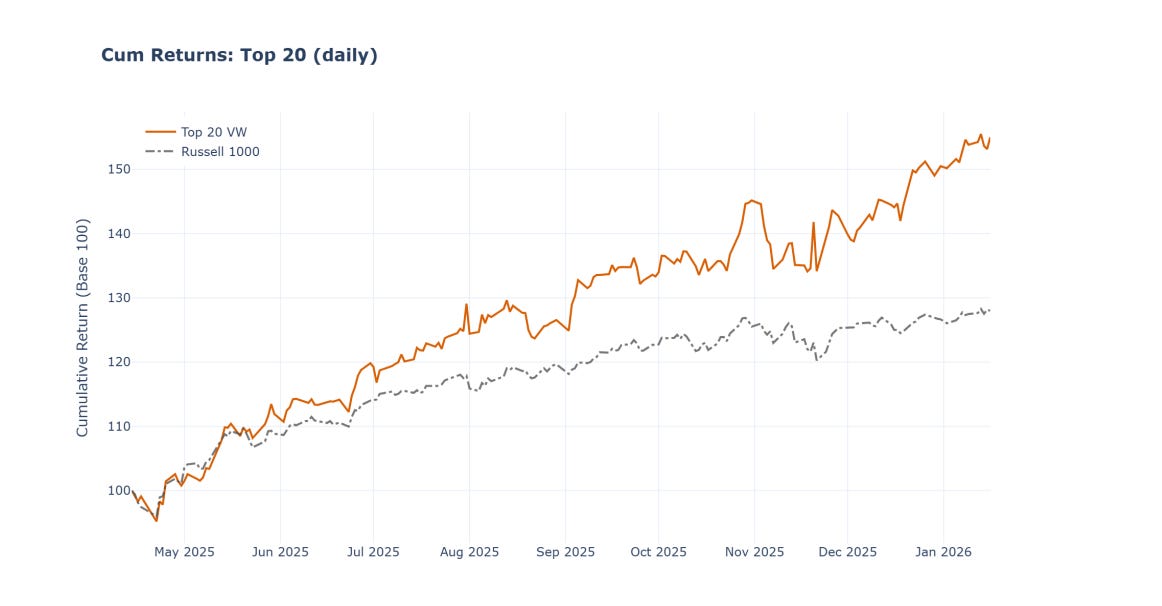
Two Peking University researchers, Zefeng Chen and Darcy Pu, did just that. They ran a live, nine-month experiment asking a frontier AI model to pick stocks every night across the Russell 1000.
Here’s what they did:
Every night from April 2025 through January 2026, they queried a leading U.S. frontier AI model via its web interface with live search enabled, with no pre-selected news or filings fed to the model. The model autonomously searched the web, synthesized what it found, and returned a score (−5 to +5) for each Russell 1000 stock.
Signals were generated after the 4pm close and before the next open. Portfolios were entered at the opening auction and exited the following open.
They ranked about 1,000 stocks by the model’s daily score, built a portfolio of the top 20 weighted by market value, and tested its performance using standard factor models.
Here’s what they found:
Detailed results, author commentary, and real-world constraints are available to paid readers.
NEWS
JPM Reorgs Bank Units Around AI
JPMorgan is restructuring its investment & commercial banking units to speed up AI adoption.
The bank has appointed longtime executive Guy Halamish as Chief Operating Officer of the CIB, giving him oversight of a new layer of chief data and analytics officers embedded inside each major business line, including banking, markets, payments, and securities services, according to Bloomberg.
Each business unit will now have its own data and analytics chief reporting jointly to Halamish and the unit head. These leaders are expected to coordinate infrastructure upgrades, deploy advanced AI models, and prepare the division for wider use of autonomous systems, including AI agents.
JPMorgan is the first large bank on the record that’s reworking its banking units around AI. Anyone who’s ever worked at a large company before knows that it’s very easy to become siloed. The bank is laying the foundation for AI to be front and center for enterprise adoption. I expect more organizations to follow.
Related
US banks wrestle with regulation amid rising AI spend CIO Dive
ICYMI


Treasury Previews AI Risk Playbook for Financial Services
Treasury says it will publish six practical resources developed with regulators and industry groups to help institutions secure data, models, infrastructure, and governance as deployment accelerates.
There’s little new policy here — the announcement mainly signals how officials want firms to think about “responsible” AI before formal rules arrive. It reads like an attempt to establish a baseline playbook for the industry. There’s currently no agreed-upon framework across the industry.
MEETUP
AI Agents in Financial Services: AI Tinkerers Milan
If you’re in Milan next week (Feb 24), come check out AI Tinkerers Milan.
I’ll be attending, and AI Street is sponsoring the event.
Expect architecture deep dives, demos, and implementation discussions. Builders from banks, insurance, and other regulated environments will be sharing how they’re deploying multi-agent systems, including reliability, failure modes, and scaling challenges.
• Le Village by Crédit Agricole, Milan
• Feb 24, 4:45–8:00 PM CET
• Space is limited and screened
How do the economics of frontier AI actually work?
OpenAI is generating billions, but the cost to build the 𝘯𝘦𝘹𝘵 model eats into its profitability -- that's the main takeaway from a new joint report from Exponential View and Epoch AI that dug into OpenAI’s finances.
That's the challenge for AI models. They're depreciating assets. They only stay state-of-the-art for a few months, so the profit earned from GPT-4o is immediately eaten by the multibillion-dollar bill to train GPT-5.
I was happy to lead a live conversation on these findings with EV's Azeem Azhar and Hannah Petrovic, PhD and Epoch AI's Jaime Sevilla.
We cover:
• The "GPT-5 unit economics" breakdown
• Why healthy gross margins aren't stopping operating losses
• Possible paths to long-term profitability
• OpenAI vs. Anthropic: Two very different playbooks
• Why this research turned some AI bulls into skeptics
ROUNDUP
What Else I’m Reading
AI Bubble Fears Are Creating Demand for Tech CDS BBG
Applying AI in multi-asset investing UBS
What Is Claude? Anthropic Doesn’t Know, Either New Yorker
Financial Services Reaches AI Tipping Point with 98% Adoption Fintech Times
Stifel CEO: Advice Is Not an Algorithm AdvisorHub
CALENDAR
Upcoming AI + Finance Conferences
CDAO Financial Services – Feb. 18–19 • NYC
Data strategy and AI implementation in the financial sector.
AI and Future of Finance Conference – Mar. 19–20 • Atlanta
Georgia Tech event featuring academic and industry leaders like the CEOs of Nasdaq and Snowflake.
AI Street is sponsoring QuantVision. Great lineup of speakers!
QuantVision 2026: Fordham’s Quantitative Conference – Mar. 19–20 • NYC
An academic-meets-industry exploration of AI-driven alpha, multimodal alternative data, and systemic risk.
Future Alpha – Mar. 31–Apr. 1• NYC
Cross-asset investing summit focused on data-driven strategies, systematic investing, and tech stacks.AI in Finance Summit NY – Apr. 15–16 • NYC
The latest developments and applications of AI in the financial industry.
Momentum AI New York – Apr. 27–28 • NYC
Senior-leader forum on AI implementation across financial services, from operating models to governance and execution.AI in Financial Services – May 14 • Chicago
Practitioner-heavy conference on building, scaling, and governing AI in regulated financial institutions.AI & RegTech for Financial Services & Insurance – May 20–21 • NYC
Covers AI, regulatory technology, and compliance in finance and insurance.
If you read this far down
Do me a favor and hit reply with the number of your favorite story from today:
Interview with Richard Craib
AI agent stock picking research
News item on JPM’s reorg