

Hey, I’m Matt. I’m a former Bloomberg News reporter, and you’re reading AI Street, where I report on how Wall Street uses AI. On Tuesdays, I highlight novel research, emerging use cases, and expert interviews.
As I’ve said a few times, AI is great at organizing messy data— the more tedious, the better. I’ve used local models on my Mac Mini to database ADV disclosures and patent applications and wrote about what I found:


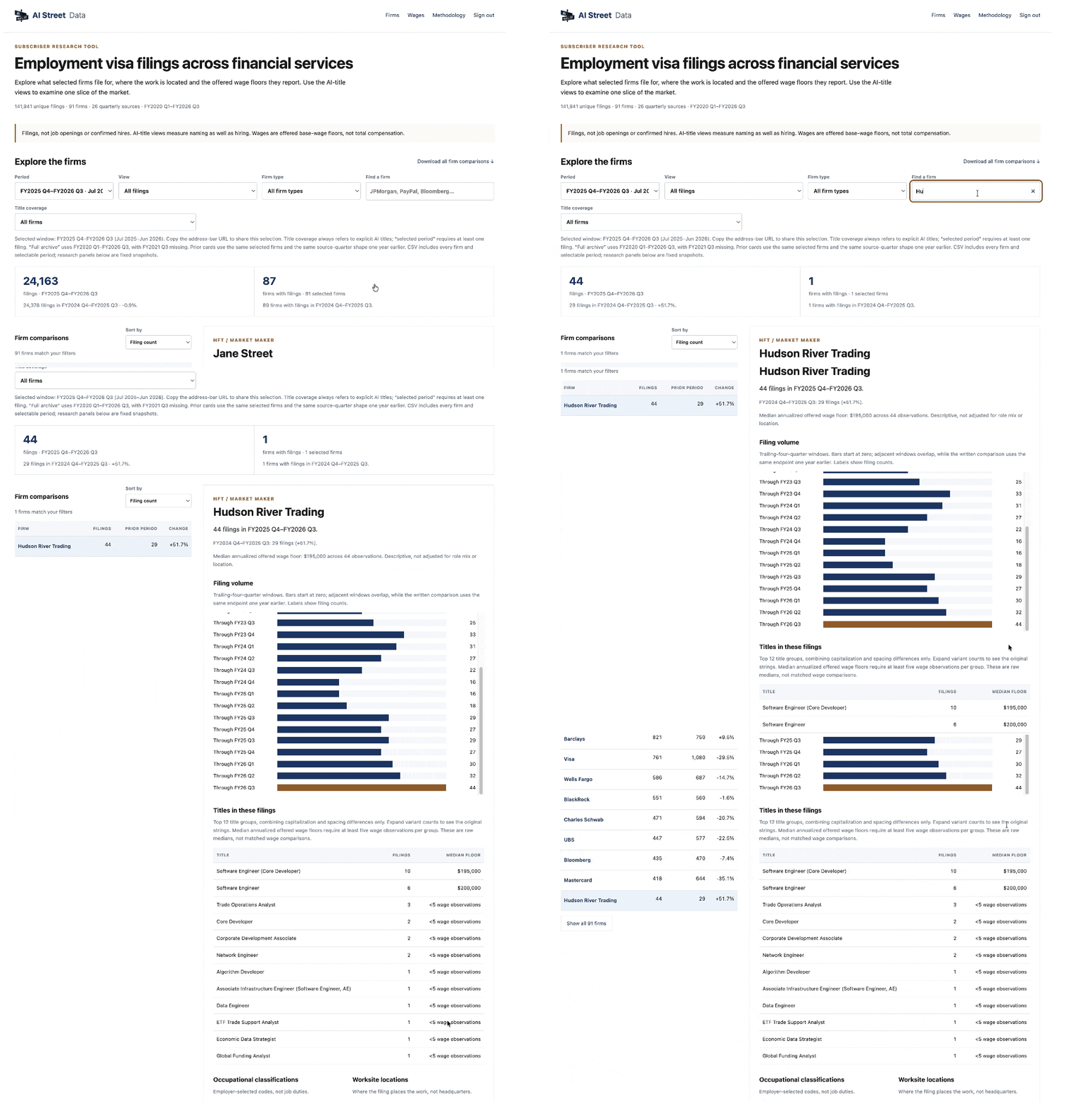
You can also use AI to turn that cleaned-up data into an interactive dashboard—which is what I did with the H-1B filings.
These required Labor Department disclosures contain job titles, locations and wages for positions tied to H-1B sponsorship. I downloaded the data here and had OpenAI’s Codex standardize employer names, like “JPMorgan” and “J.P. Morgan,” identify duplicate case records and turn the data into a dashboard.
AI Street Dashboard
Paid subscribers can access the interactive dashboard using the password provided at the bottom of this email.
What the Filings Show
The dataset covers 141,941 unique filings from 91 finance firms, drawn from 26 quarterly releases spanning fiscal 2020 through fiscal 2026’s third quarter.
In the four quarters through June, H-1B filings from the 91 financial firms reviewed were roughly flat, declining about 0.9%. Nationwide filings fell 8.8% year over year in the first three quarters of fiscal 2026. (Nationwide H-1B-related applications peaked in fiscal 2022 and have remained below that mark since.)
Some important nuances: these filings are part of the H-1B sponsorship process, not evidence that someone was ultimately hired. One filing can cover multiple positions, and the salary figures show only the minimum base pay offered—not bonuses, equity or other compensation.
Three Firms Accounted for the Largest Increases
Fidelity, Citigroup and PayPal saw the biggest jumps in filings, adding 1,397 together. Excluding those firms, filings at the remaining firms declined about 8.2%.

The Banks Split
Citigroup and Morgan Stanley reported more filings. Bank of America, UBS and Deutsche Bank reported fewer.
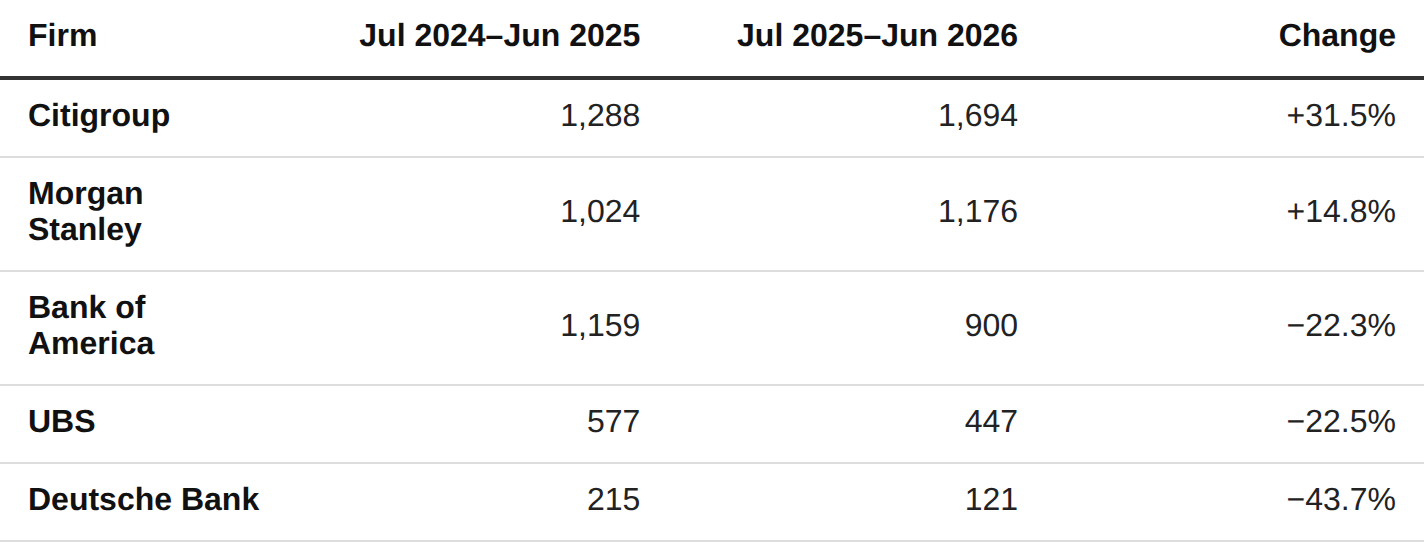
(These are examples, not an exhaustive sector ranking. The dashboard and its download include every firm in the sample, including those with small changes or few filings.)
Payments Firms Moved in Opposite Directions
PayPal filed 23.1% more applications, while Visa and Mastercard filed 29.5% and 35.1% fewer, respectively.

AI Titles Only Make up 2%
Applications with explicit AI titles grew, but remained a sliver of the market, accounting for just 2% of filings, up from about 1% a year earlier.
JPMorgan and PayPal accounted for many of the explicit AI-title filings, with positions such as applied AI leads and machine-learning engineers. Bloomberg’s filings included a “Senior NLP Research Engineer.”
Meanwhile, 11 firms with at least 500 qualifying filings had no explicit AI titles in the archive. They include Goldman Sachs, Citigroup, Bank of America and Morgan Stanley. That does not mean those firms do no AI work: the data only captures job titles. Explore those firms.
What Firms Offer for AI-Titled Roles
Within employer-and-occupation groups containing both kinds of title, the raw median annualized offered wage floor was $170,000 for explicit AI titles and $145,000 for the comparison group—a $25,000 difference.
But much of that gap reflected differences in occupation, location and seniority. After accounting for those factors, the estimated difference narrowed considerably and should not be interpreted as a universal “AI premium.” See the fixed wage comparison and its limitations.
Data & Methodology
The analysis covers 141,941 H-1B filings linked to 91 selected finance firms. I standardized employer names and removed duplicate case records. Filings are not confirmed hires, and one filing can cover multiple positions. You can read the full methodology—including the employer-matching, AI-title and wage-analysis rules—on the dashboard.