

Hey, I’m Matt. I’m a former Bloomberg News reporter, and you’re reading AI Street, where I report on how Wall Street uses AI.
Agentic Bond Trading
LTX, Broadridge’s corporate bond trading platform, now allows users to create AI agents on its BondGPT app to handle parts of the trading workflow on their own. The agents can build trade tickets, select dealers, send out requests for quotes, and auto-execute certain trades, according to a release this week. (LTX says traders set the parameters and remain in control.)
This is the first case I know of where AI agents can perform agentic actions in the bond market. I’m sure others will follow. (The stock market already has a few agent trader options.)
Bond markets have used automated trading for decades. But that automation was generally driven by explicit rules. What makes agentic AI different is that you can define a goal without having to define every little step in how to obtain that goal. The bond market, as I’ve said before, is well suited for AI because its informational infrastructure is way more scattered than the stock market’s.
A NOTE FROM OUR SPONSOR

The data existed. You just couldn’t get to it in time.
Consumer transaction signals diverged weeks before the earnings miss. Payroll data pointed to a labor market shift before the official print. Foot traffic told the story before the guidance cut. The signal was there, in data assets that took months to source, clean, and deliver under the old model.
Carbon Arc’s Lenses puts that signal in your workflow today. 210+ data assets, daily refresh, queryable in plain English.
Start querying with Lenses using code AISTREET30 for 50% off your first month.
When Academia & Wall Street Meet
Michael Milken is well known for turning junk bonds into an asset class.
Less well known is that he got the idea from academia.
As an undergrad at the University of California at Berkeley in the 1960s, Milken stumbled across a book published a decade prior called Corporate Bond Quality and Investor Experience. The research studied yields and defaults from 1900 to 1943 and showed that investors overestimated the risk of higher-yielding bonds.
“I was struck by the disparity between theory and reality,” Milken said on his website in 2014. “The prevailing theory—that markets accurately adjust yield to compensate for higher risk—was clearly wrong.”
Academic research often makes its way to Wall Street as Black-Scholes did in options pricing and Fama-French did in factor investing. Academic work also uncovered fraud in the options-backdating scandal.
Despite this history, the two mostly operate in different worlds. Academia and industry don’t really interact much. Academics have their conferences and fintech folks have theirs.
That’s why I was happy to attend Future of Finance Fest (3f) earlier this month in Amsterdam. David Stolin, a finance professor at Toulouse Business School, created the event to get academic and industry folks in the same room.
The one-day conference hosted a series of 15-minute talks on practical ways to leverage technology in financial services. The atmosphere was collegial and informal. I participated in an impromptu panel with Validation Cloud’s Ralf Kubli and University of Amsterdam’s Simon Trimborn. David called us up from the crowd.
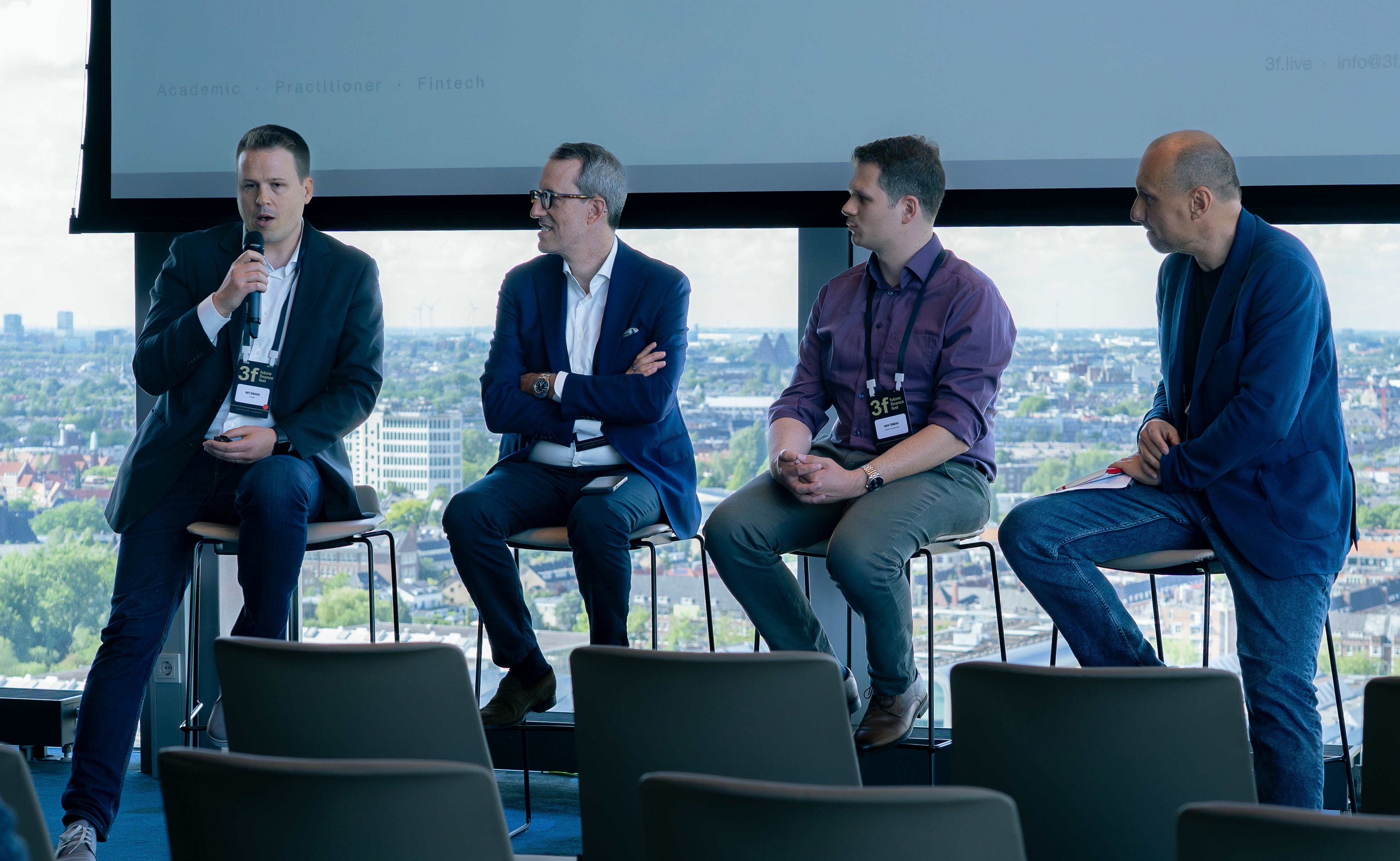
The topic, naturally, was driving more conversations between researchers and business people. I shared a few thoughts. Academics should seek broader publication of their research beyond academic journals and post research summaries for a general audience on social media. Industry folks: don’t forget academics have often spent years working in obscurity on narrow problems and are generally more than happy to chat about their work.
The event will be back in Amsterdam next year on June 11, 2027 (right after Money20/20). If you’d like to get involved or speak, please reach out to David at chair@3f.live.
Regulators Press Banks for Details on AI Use
Reuters has a story out this week on banking regulators ramping up scrutiny of AI by asking lenders to show how they use AI, what risks it creates and what controls they have in place.
While U.S. financial regulators have written few new rules aimed directly at AI, there are still rules to follow. These laws are broadly written and meant to capture and regulate new technologies. (Crypto bros learned this a few years ago.)
In a prior life, I wrote about financial regulation at Bloomberg News. Federal agencies often start with the easy cases, which are just old-school fraud. You said X publicly, but privately Y was happening, like this one. After that, regulators start working their way up into more novel cases and asking questions such as these: What sort of policies and procedures do you have in place for this use case? What due diligence did you perform on this vendor? Etc.
Answers to these questions are not black-and-white, and best practices are still emerging. I expect more of these nuanced cases in the next year or so, not because people are up to no good, but because this technology is complex and it’s hard to get tens of thousands of employees on the same page.
Top Banks Rush to Fill Chief AI Roles
Bloomberg has a story out about the growing demand for chief AI officers at financial services firms. The creation of this new role is a topic I’ve previously written about. It is not easy for a company to adopt a probabilistic technology that is known to consistently make things up. You need someone to get different, often feuding divisions to work together.
These people are hard to find. How many people really have years of in-depth experience working in AI, who aren’t already working at Anthropic or OpenAI?
The Bloomberg piece points out that folks within the industry believe that these chief AI roles will be short-lived.
“We don’t have head of mobile devices,” Peng Zhao, chief executive officer of Citadel Securities, told a gathering at the Global Financial Leaders’ Investment Summit in Hong Kong in November.
I can see the role morphing into a Chief Technology Officer or CIO. But I sort of think the Chief AI role is here to stay, at least for a while. There are a lot of problems to solve with adoption. Computing costs are exploding across companies. Who manages that? Each individual department head? How do you decide which use cases to spend those resources on? Those seem like hard questions to me.
Link Roundup
HSBC partners with Google Cloud to expand AI usage | Reuters
Race to Turn AI Compute Into a Commodity Spurs New Crypto Boom | BBG
OpenAI hires Citadel’s risk data engineering head in London | efinancialcareers
Tradeweb rolls out AI-powered research assistant | The Trade
Moody’s connects intelligence to Amazon Quick | Finextra
This Week in AI Street
I’ve spent the last few weeks writing about how AI agents still have a ways to go in terms of reliability. Most recently, I wrote about how challenging it is getting AI to remember:
Why AI Agents ‘Age’

Agents forget facts, retain outdated information, and ignore their own notes after only a handful of prompts, according to new research.

CIOs managing billions in assets read AI Street.
Paid subscribers access original reporting, data analysis, and interviews with the executives and researchers leading Wall Street’s AI buildout.
CALENDAR
Upcoming AI + Finance Conferences
IAQF + LSE: AI/ML in Finance – June 23 • London
Finance-focused AI/ML conference hosted by IAQF with LSE involvement.
New York Fed Innovation Conference – June 25 • New York
Research/policy conference on financial-sector innovation (payments, regulation, fintech, and related themes).
32nd Computing in Economics and Finance – June 29 • Venice
Academic conference on computational methods in economics/finance (numerical methods, simulation, macro/asset pricing, econometrics).
The Fin AI Symposium 2026 – July 3 • San Diego
Industry symposium focused on applied AI in finance, with practitioners sharing tooling, workflows, and deployment lessons.
Artificial Intelligence for Financial Services – July 23–24 • Cambridge, MA
MIT executive-education workshop on AI/ML applications in financial services, emphasizing strategy, use cases, and implementation considerations.
SPONSORSHIPS
Reach Wall Street’s AI Decision-Makers
AI Street reaches institutional investors, C-suite executives and Big Law attorneys at firms including JPMorgan, Citadel, BlackRock, Skadden, McKinsey, and more. Sponsorships are reserved for companies in AI, markets, and finance. Email sponsors@ai-street.co for more details.
Thanks for reading!
I’m always happy to receive comments, questions, and feedback.
connect with me on LinkedIn, or
send an email to matt [at] ai-street.co
Not this year, unfortunately. Colleagues reported a heavy AI agenda but limited insight, still nearer the start than middle as far as FI is concerned.
Great round up as always, Matt.
Time will tell on the AI bond trading, a lot of the news this week was to co-incide with the important FILS conference in Boston.